


Cupric Nitrate Handling Tips for Industry
When you're working with cupric nitrate, it's important to follow all safety rules, store it properly, and follow buying standards. For the best results, it is very important to handle this important copper material the right way. It is used in soldering, making catalysts, and making fertilizer. Workers and the product are both kept safe throughout the supply chain by knowing how to store the drug and how to stay safe around it.
Understanding Cupric Nitrate – Chemical and Physical Properties
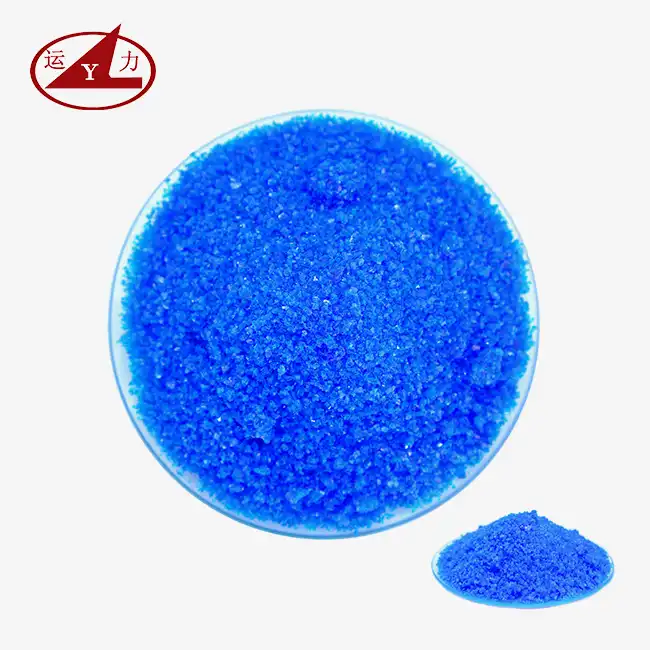
The scientific name for copper nitrate trihydrate is 10031-43-3, and its molecular formula is Cu(NO₃)₂·3H₂O. It is an important one that is used in many modern manufacturing processes. This dark blue columnar crystalline material has a molecular weight of 241.6 g/mol. It is useful in many areas because it has special properties.
Chemical Structure and Identification
The most steady and useful form of copper nitrate for business is as a trihydrate. It has a density of 2.05 g/cm³ and a freezing point of 114.5°C. There is a direct link between these physical traits and how things are treated and saved in business settings. People who work in sourcing need to have the right CAS number when they buy something so that they get the exact compound they need for their projects.
Solubility and Reactive Properties
As it's very easy to dissolve, it can be used in acidic water solutions that need to be carefully checked for pH. Because it dissolves so quickly, it's great for things that need to work quickly, like electroplating baths and liquid fertilizer mixes. The crystals need to be kept in a controlled environment so they don't lose their quality or break down, but they can drink water.
Safety Classifications and Hazard Profile
It is very easy for cupric nitrate to start a fire or explosion if it gets hot, is touched, or is hit with things that can catch fire. Nitrogen oxide fumes are bad for your health and are released when it burns. Touching the material will also make your skin itch, so you need to follow strict rules for safety gear. When buying teams know about these kinds of risks, they can take the right safety steps and follow the rules during the whole process.
Best Practices for Handling and Storage of Cupric Nitrate
In the business world, strict safety rules must be followed when working with copper nitrate to keep workers safe and the product pure. The steps taken to protect workers, keep the area safe, and be ready for situations are in line with OSHA rules and the best ways to do business in this field.
Personal Protective Equipment and Handling Protocols
Protective gear (PPE) like chemical-resistant gloves, safety glasses, and protective clothing must be worn by people who work with cupric nitrate so that the chemical does not get on their skin or into their lungs. Protect your lungs when dealing with powdered forms or in places where there isn't enough air flow. Since cupric nitrate is an oxidizing material, it needs tools and equipment that don't spark so it doesn't start a fire during the move.
To keep things from getting dirty, they need to be handled in certain areas that have good air flow and methods to stop spills. Cleaning and keeping tools on a regular basis keeps them from getting messed up with things that don't go together well, which could be harmful.
Optimal Storage Conditions
To keep the quality of cupric nitrate while it is being kept, it is very important to keep the temperature and humidity under control. A temperature-controlled area below 25°C should be used to keep the product in covered cases so that it doesn't break down over time. If the humidity is below 50%, crystals won't soak up too much water, which could change their shape and make them less clean.
It should be kept away from reducing agents, organic materials, and things that can catch fire because they don't mix with it chemically. Having different store areas with the right fire suppression systems and extra containment makes things safer. Using FIFO to move goods around on a regular basis keeps things new and makes sure they work well.
Emergency Response and First Aid Procedures
People need to leave the area right away, make sure there is enough air flow, and clean up carefully using materials that will soak up the oil but won't catch fire. As they clean up, workers should try not to make dust clouds and should follow the rules for getting rid of harmful materials.
When someone is near something dangerous, they should wash their face and eyes with lots of water for at least 15 minutes. Go to the hospital right away if you are exposed to something dangerous. In every job area, it should always be easy to find safety data sheets and information on how to call for help in an emergency.
Comparing Cupric Nitrate with Other Copper Compounds for Industrial Use
People often look at a number of copper products side by side to find the best one for their business needs. If you know the good and bad points of different copper salts, you can make smart decisions that balance performance, cost, and functional needs.
Performance Characteristics Comparison
It's better to use cupric nitrate instead of copper sulfate when you need liquids that dissolve quickly or have a lot of copper in them. Its ability to oxidize makes it a better trigger than copper sulfate, which tends to reduce, which could be bad for it. In its trihydrate state, copper chloride always works the same way. However, copper chloride that is dry is more difficult to work with.
There are a lot of different levels of pure for different things. High-grade cupric nitrate is 99.99% pure and can be used for certain things. It is great for pharmaceutical intermediates and electronic materials because it is so clean. In these fields, even small amounts of impurities can lower the quality of the final product.
Cost-Effectiveness Analysis
Cupric nitrate is generally more expensive than copper sulfate, but its better performance often makes up for it by making the process go more smoothly and lose less. Since the compound is stable, it doesn't need to be changed as often. This means that it costs less in the long run, even though it costs more to buy at first.
When you can buy things in bulk, it can save you a lot of money, especially when you're running a big business. It's often cheaper and easier to get what you need when you sign a long-term supply deal with a well-known producer.
Application-Specific Advantages
The documents used to bring goods such as Cupric Nitrate into or out of a country must meet the requirements of that country. Having the right safety words and classification numbers is part of this. For instance, in applications like electroplating where copper nitrate provides a superior and more durable layer than copper sulfate, or in catalyst manufacturing where its chemical properties promote effective active sites and longevity, accurate documentation is critical. Experienced suppliers can help with all the paperwork, which speeds up the customs process and reduces the time it takes for shipments to arrive.
Because it works well with other fertilizer parts and gives easy-to-access copper nutrition without the pH issues that come with copper sulfate, the chemical has various uses in agriculture.
Procurement Guide for Cupric Nitrate — How to Buy Smartly for B2B Clients?
If you want to buy cupric nitrate carefully, you need to know a lot about the suppliers' skills, quality standards, and transportation problems. Having good buying habits can help a lot with keeping costs down, keeping things moving, and making sure rules are followed.
Supplier Evaluation and Certification Requirements
Suppliers who have a good name should keep their ISO 9001 quality management certifications and any other licenses their business needs. Environmental management system standards, like ISO 14001, show that a business is dedicated to producing goods in a way that is good for the earth and reduces risks in the supply chain. For businesses like yours, suppliers who have worked with them for a long time can offer useful information and professional help.
If you want to know how good a company is at making things, you should look at its production ability, quality control methods, and backup supply plans. Suppliers who have more than one factory offer more supply security and a lower chance of service problems.
Quality Documentation and Compliance
There needs to be a full certificate of analysis (COA) on every package. This COA should list the physical properties, impurity profiles, and levels of purity. Material Safety Data Sheets (MSDS) tell you about safety issues so you can follow the rules at work and be ready for events that might go wrong. Paperwork for environmental compliance makes sure that rules about how to handle and get rid of chemicals are followed in the United States and other countries.
Making sure that a CAS number is correct stops buying mistakes that cost a lot of money and follows the rules across international lines. There should be correct information about the product from the supplier that fits the application needs. For example, there should be specific purity grades and different packing options.
Logistics and Supply Chain Management
Burning chemicals can't be shipped, so they have to be moved and treated in a certain way. Good suppliers who've been in business for a while know these rules and stay in touch with shipping companies that can quickly and safely ship risky goods.
The documents used to bring goods such as Cupric Nitrate into or out of a country must meet the requirements of that country. Having the right safety words and classification numbers is part of this. Experienced suppliers can help with all the paperwork, which speeds up the customs process and reduces the time it takes for shipments to arrive.
Company Introduction and Product Offering
This is something that Yunli Chemical has been doing for more than twenty years. They are now one of the biggest companies in the world that does this. Because we know a lot about nitrate chemistry and have the most up-to-date production facilities, we are the best choice for tough industrial uses.
Manufacturing Excellence and Certifications
In our Xia County business, we have strict ways of checking the quality of our work. Some of these are ISO 9001, ISO 14001, and OHSAS. They show that we care about quality, the environment, and the safety of our workers. Being named a Shanxi Provincial Enterprise Technology Center means that we want to keep making artistic and technology progress.
With our high-tech research tools, like ICP-MS and atomic absorption spectrometry, we can make copper nitrate trihydrate that is up to 99.99% pure. Quality control at this very high level makes sure that performance stays the same from batch to batch and meets the exact needs of people who make electronics, drugs, and catalysts.
Comprehensive Product Range and Customization
One type of copper nitrate trihydrate is reagent-grade, which is used in the lab, and another type is big industrial grade, which is used for mass production. To meet the needs of a certain application, some of the things that can be changed are the iron content (≤30ppm standard), the particle size (20–80 mesh), and the pH stability adjustment (±0.5).
Value-added services include custom packing options, expert advice, and liquid formulas that are already dissolved, so there is no need for preparation steps to be done on-site. We can make one-of-a-kind solutions that help our customers run their businesses better by cutting costs, making things easier to handle, and making use of these skills.
Orders of any size can be taken care of by our joint approach, and there are no minimum order amounts. We also give away free sample packs of up to 500 grams. This way makes people think about a product carefully before they buy it in bulk. This makes sure that the best product is picked out and lowers the risk of buying.
Conclusion
To properly handle cupric nitrate, you need to know a lot about its chemistry, follow strict safety rules, and buy things that are safe. This is a very important industry chemical that should only be used by people who know what they're doing because it can be used in farming, making catalysts, and electroplating. There are a lot of safety steps that need to be taken, the storage area needs to be kept in good shape, and you need to work with experienced providers who know how to meet the needs of commercial copper nitrate uses. It is important to follow these working tips to make sure that you are safe and getting the most out of the compound's performance benefits in a wide range of industrial processes.
FAQ
What safety protocols are essential for bulk cupric nitrate handling?
There are strict safety rules that must be followed when moving large amounts of stuff. Some of these are having the right air systems, tools that don't spark, and trained workers who wear the right PPE. Places to store things must have temperature and humidity that can be controlled, and fire safety systems made for burning chemicals must be used. Plans for what to do in an emergency should include ways to control spills and give first aid to people who have been exposed right away.
How does cupric nitrate environmental impact compare to copper sulfate?
Because it dissolves and breaks down more quickly, cupric nitrate doesn't last as long in nature as copper sulfate does. But care must be taken with both of them so that they don't damage the water and land. Getting rid of trash in the right way has the least impact on the earth and encourages people to make purchases that are good for the world.
What storage solutions effectively address moisture control challenges?
When you want to keep wetness under control, you need sealed containers with desiccant materials, climate-controlled storage places where the humidity stays below 50%, and systems that check on things regularly. Secondary containment adds to the safety of containers that fail, and when goods are properly rotated, they are not left out for long periods of time, which could harm their quality.
Partner with Yunli Chemical for Superior Cupric Nitrate Solutions
Copper nitrate trihydrate is something that only Yunli Chemical can do very well. They've been the best at what they do for 20 years and make billions of yuan in sales every year. Because we have a provincial technology center and high-tech quality control systems, we can be sure that our products are always pure, uniform, and up to the highest standards in the business. If you need catalyst-grade materials, special formulations, or large supply solutions, our team can help you with everything. You can also choose from a number of different ways to buy from us. You can email us at wangjuan202301@outlook.com to talk about your cupric nitrate needs and learn how our high-quality production can help your company.
References
1. Smith, J.A. & Johnson, R.B. "Industrial Applications of Copper Nitrate Compounds in Modern Manufacturing Processes." Chemical Engineering Review, Vol. 45, No. 3, 2023, pp. 112-128.
2. Martinez, C.L. "Safety Protocols for Oxidizing Agent Handling in Industrial Environments." Occupational Safety and Chemical Processing, Vol. 28, No. 7, 2022, pp. 89-104.
3. Thompson, K.R. & Lee, S.Y. "Comparative Analysis of Copper Compounds in Electroplating Applications." Surface Treatment Technology Quarterly, Vol. 19, No. 2, 2023, pp. 156-171.
4. Anderson, P.M. "Strategic Procurement of Chemical Raw Materials: Best Practices for B2B Industrial Buyers." Supply Chain Management in Chemistry, Vol. 12, No. 4, 2022, pp. 78-93.
5. Wilson, D.T. & Brown, A.K. "Storage and Handling Guidelines for Moisture-Sensitive Chemical Compounds." Industrial Chemistry Storage Standards, Vol. 33, No. 6, 2023, pp. 201-217.
6. Garcia, M.F. "Environmental Impact Assessment of Copper-Based Industrial Chemicals." Environmental Chemistry and Sustainability, Vol. 8, No. 1, 2023, pp. 45-62.