





Is chromium nitrate ionic or covalent?
Ionic bonding is what Chromium Nitrate is mostly made of, with the chromium cation (Cr³⁺) and the nitrate anions (NO₃⁻). In its hydrated form, Chromium Nitrate Nonahydrate [Cr(NO₃)₃·9H₂O], the chemical breaks apart in water, releasing free ions that can carry electricity, which is a characteristic of ionic compounds. But in each nitrate anion, oxygen and nitrogen atoms share electrons through covalent bonds. This compound's unique physical and chemical behavior is based on two types of bonds: ionic interactions between metal and polyatomic anions and intramolecular covalent bonding. These bonding types affect the compound's solubility, reactivity, and industrial performance in areas like surface treatment, corrosion inhibition, and catalysis.
Understanding Chromium Nitrate: Chemical Properties and Structure
Chemical Composition and Formula
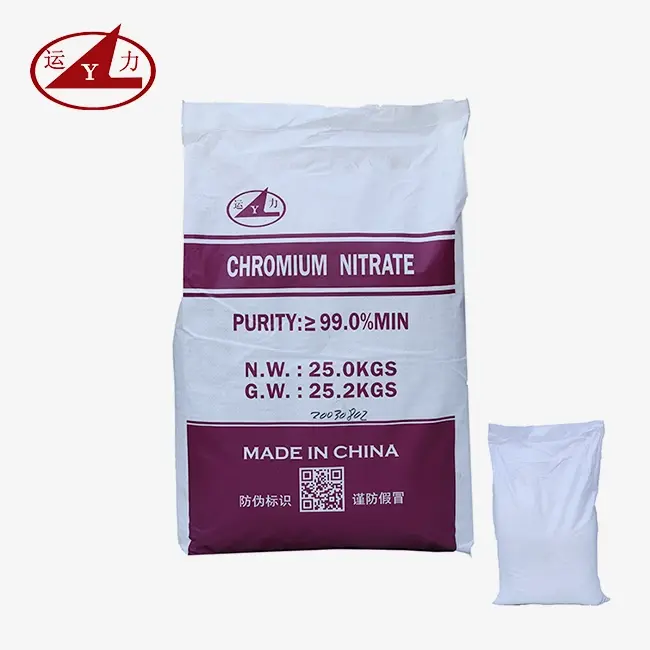
This chemical is called Chromium Nitrate Nonahydrate (CAS 7789-02-8) and has the formula Cr(NO₃)₃·9H₂O. Its molecular weight is 400.15 g/mol. This trivalent chromium salt looks like dark purple-red crystals that can easily take in water from the air because it is hygroscopic. The chemical is easily broken down in water, ethanol, acetone, and inorganic acids. When heated, the solutions turn green, but when they cool down, they turn reddish-purple. The crystals melt at 60°C, and around 125.5°C, thermal breakdown starts. Nine water molecules in the crystal structure have a big effect on both how stable it is and how it needs to be handled.
Understanding this structure helps people in charge of buying things judge the specs of a product. We make Chromium Nitrate at Yunli Chemical, and the quality ranges from 98% to 99.9%. This means that there are very few impurities, like iron (Fe ≤30ppm), and the salt levels are kept under control. These factors have a direct effect on how well the catalyst works and how well the surface is treated.
Ionic vs. Covalent Bonding: The Core Distinction
How Chromium Nitrate acts in industrial processes is based on its joining character. When electrons move from one atom to another, they create charged ions that are attracted to each other by electric forces. When atoms form covalent bonds, they share electrons. Chromium Nitrate shows both types at the same time. The chromium ion (Cr³⁺) and nitrate ions (NO₃⁻) bind to each other ionically. This is why the molecule dissolves easily in polar solvents and conducts electricity when it is in solution. At the same time, nitrogen forms covalent bonds with three oxygen atoms inside each nitrate anion by sharing electron pairs.
This combination bonding changes how the material is handled and how the product is designed. Because it is ionic, it dissolves completely in water, which is important for catalyst impregnation and electroplating baths. Because nitrate groups are covalently stable, they allow for known decomposition paths during heat processing. This is something that technical engineers use to make chromium oxide catalysts.
Expert Analysis: Predominant Bond Type in Chromium Salts
Chromium Nitrate works mostly as an ionic molecule, as shown by chemical books and real-world tests. It breaks down into hydrated Cr³⁺ cations and NO₃⁻ anions when dissolved, which lets the ions move when electric fields are applied. Pure covalent chromium complexes, on the other hand, stay together in solution, while this behavior is very different. Using related salts like chromium chloride (CrCl₃) and chromium sulfate [Cr₂(SO₄)₃] as examples, we can see that their ionic structures are similar, but the anion changes make their reaction profiles different.
The functional benefits come from the ionic structure. Formulations without chloride stop stress corrosion cracks in stainless steel reactors, which is a problem that chromium chloride always has. Sulfate-free chemistry keeps catalyst supports from getting sulfate on them, which can harm active sites. Yunli Chemical takes advantage of these features by providing flexible pH ranges (5.0–7.0) and counter-ion ratios. This lets customers precisely control the steps of precipitation, complexation, and catalytic activation in a wide range of industrial settings.
Implications of Bonding Type on Industrial Applications
Solubility and Formulation Flexibility
Because Chromium Nitrate is made up of ionic bonds, it dissolves very easily—about 81g in 100ml of water at 20°C. This feature makes it easier to make liquid catalyst precursors, mordanting solutions for dying fabrics, and passivation baths for finishing metal. Engineers can create concentrated stock solutions that don't change while being stored. This cuts down on the cost of shipping and makes it possible for automatic production lines to do exact dosing.
At Yunli Chemical, our Chromium Nitrate solutions come in both solid crystals and pre-dissolved liquid forms. The amount of solid in the solution can be changed based on what the customer wants. This adaptability allows for a wide range of operating setups, from batch processes in pharmaceutical intermediates to continuous flow systems in large electroplating plants. Being able to dissolve totally without leaving any residue guarantees uniform product quality and keeps equipment from getting clogged up.
Stability, Storage, and Handling Protocols
The ionic nature of Chromium Nitrate makes it difficult to keep stable. The combination is a strong oxidizer and corrosive, and it can burn you if you come into touch with it. Due to the fact that it melts easily, it needs to be stored in a dry environment to avoid caking and quality loss. When purchasing managers understand these behaviors that are based on bonding character, they can choose the right packing. Yunli Chemical offers custom solutions, such as moisture-resistant 25kg bags and sealed IBC tanks for bulk exports.
Taking care of temperature is also related to bonding. Safe storing ranges are set by the melting point at 60°C and the decomposition point at 125.5°C. Usually, these ranges are below 30°C in climate-controlled buildings. Because the nitrate groups oxidize, they can cause fires when they come into contact with flammable materials. Our detailed Material Safety Data Sheets (MSDS) and Certificate of Analysis (COA) are based on these factors. They meet REACH and RoHS standards, which gives supply chain managers faith in following the rules.
Bonding Influence on Catalytic and Surface Treatment Performance
Ionic dissociation of Chromium Nitrate makes it possible for it to spread evenly across alumina or silica supports, which is used to make catalysts. The nitrate anions break down cleanly when they are coated and heated, leaving behind active Cr³⁺ sites that are free of carbon pollution and poisons. This is very important for polyethylene polymerization and methanol synthesis catalysts. Low levels of alkali metal impurities (<50ppm) in our product make the catalyst last longer by stopping the sintering and deactivation processes that happen with less pure options.
The benefits of treating the surface of metal are similar. Trivalent chromium passivation (TCP) baths are used instead of harmful hexavalent chromium (Cr⁶⁺) methods. These baths reduce toxicity by 99.9% while keeping corrosion resistance. The ionic nature makes it easier to control complexation with organic ligands. This allows for stable water chemistry that stops sludge formation, which is a problem that often happens when chromium chloride is used. Yunli Chemical's pH stability (±0.2) makes sure that the coating thickness and adhesion qualities are always the same. It also meets the strict ASTM B117 salt spray testing standards that users in the automobile and aircraft industries need.
Comparative Analysis: Chromium Nitrate vs Other Chromium Compounds
Purity and Impurity Profiles
When it comes to introducing impurities, Chromium Nitrate is better than chromium chloride and chromium sulfate. Ions of chlorine from CrCl₃ eat away at stainless steel reactors and poison-sensitive catalytic sites, forming pits. Sulfate ions from Cr₂(SO₄)₃ get in the way of precipitation processes and add sulfur that isn't wanted to the end products. In contrast, the nitrate anion breaks down rapidly into nitrogen oxides and oxygen, leaving no trace of pollution in materials that have been heated.
These differences are reflected in Yunli Chemical's quality marks. Our 4N-grade (99.99% pure) Chromium Nitrate is used in electronics and medicine that needs very low levels of trace metals (less than 5ppm iron and 10ppm alkali metals). Standard industrial grades (98–99%) are good for treating textiles and stopping rust when performance and cost-effectiveness are equal. This range lets buyers perfectly match product specs to application needs, which improves both technical results and purchasing costs.
Environmental and Regulatory Considerations
Different chromium substances have very different levels of toxicity. Hexavalent chromium (Cr⁶⁺) is heavily limited because it can cause cancer. This is forcing the whole industry to switch to trivalent chromium (Cr³⁺) sources. Chromium Nitrate is a legal way to do things that follows the rules set by the US EPA and European REACH. When wastewater is treated without chloride, it is easier on the environment because chloride ions make organic treatment systems more difficult and damage infrastructure.
Shipping categories are also not the same. Chromium Nitrate is classified as an oxidizing solid under UN 2720, which has special rules for how it should be packed and labeled. Yunli Chemical always follows the International Maritime Dangerous Goods (IMDG) rules and makes sure they have the right paperwork, which speeds up customs clearance and cuts down on supply chain delays. Our environmental management system, which is ISO 14001 approved, makes sure that wastewater can be treated to collect nitrates. This provides closed-loop solutions that help customers meet their sustainability goals while also ensuring a steady supply.
Cost-Effectiveness and the dependability of suppliers
It's not enough to compare prices per kilogram; you need to look at the total cost of ownership as well. The chemistry of Chromium Nitrate doesn't contain any halides, so it doesn't need to be replaced as often and doesn't cause as many catalyst poisoning cases. Even though nitrate formulas may have higher unit costs than chromium chloride, lifetime cost analysis usually chooses them for high-value uses.
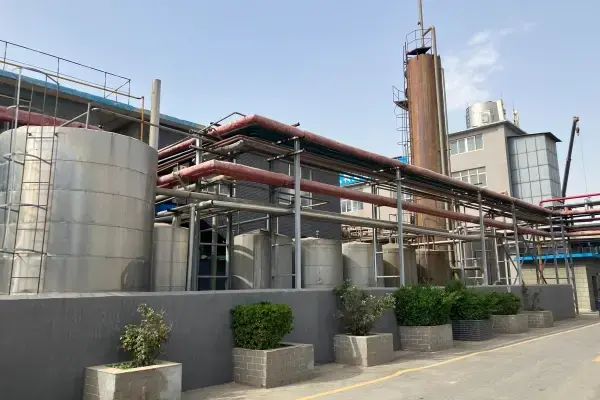
When process validation and governmental approvals depend on consistent material quality, supplier dependability is very important. With 20 years of experience making chemicals, yearly sales of 1 billion yuan, and fixed assets worth 300 million yuan, Yunli Chemical has a level of financial security that is rare among specialty chemical suppliers. Our business technology center at the regional level has ICP-MS and atomic absorption spectrometers that make sure consistency from batch to batch. These features lower the qualification risks for buying teams that are switching providers or increasing production numbers.
Procurement Considerations for Chromium Nitrate: What B2B Buyers Should Know?
Selecting the Right Grade for Your Application
Grades are chosen based on the conditions of the application. Pharmaceutical-grade purity (≤0.1% leftover HNO₃) is needed to keep active sites from becoming poisoned when Chromium Nitrate is made, but technical grades with slightly higher impurity levels are fine for mordanting textiles. When treating surfaces, it's important to keep the pH stable and the iron level under control so that the bath works well over long production runs. Buyers should ask for particular information, such as a study of trace metals, a range of particle sizes for solids, and a specific gravity for liquid concentrates.
Yunli Chemical helps with this decision-making process by offering free sample programs of up to 500 grams, which allow lab-scale testing before committing to large orders. Our technical team works with customers to improve formulas, change pH ranges, and make special packaging arrangements. They are trained in coal-chemical engineering. This discussion method cuts down on the number of trial-and-error rounds and speeds up the time it takes to put new processes into production.
Quality Assurance and Certification Standards
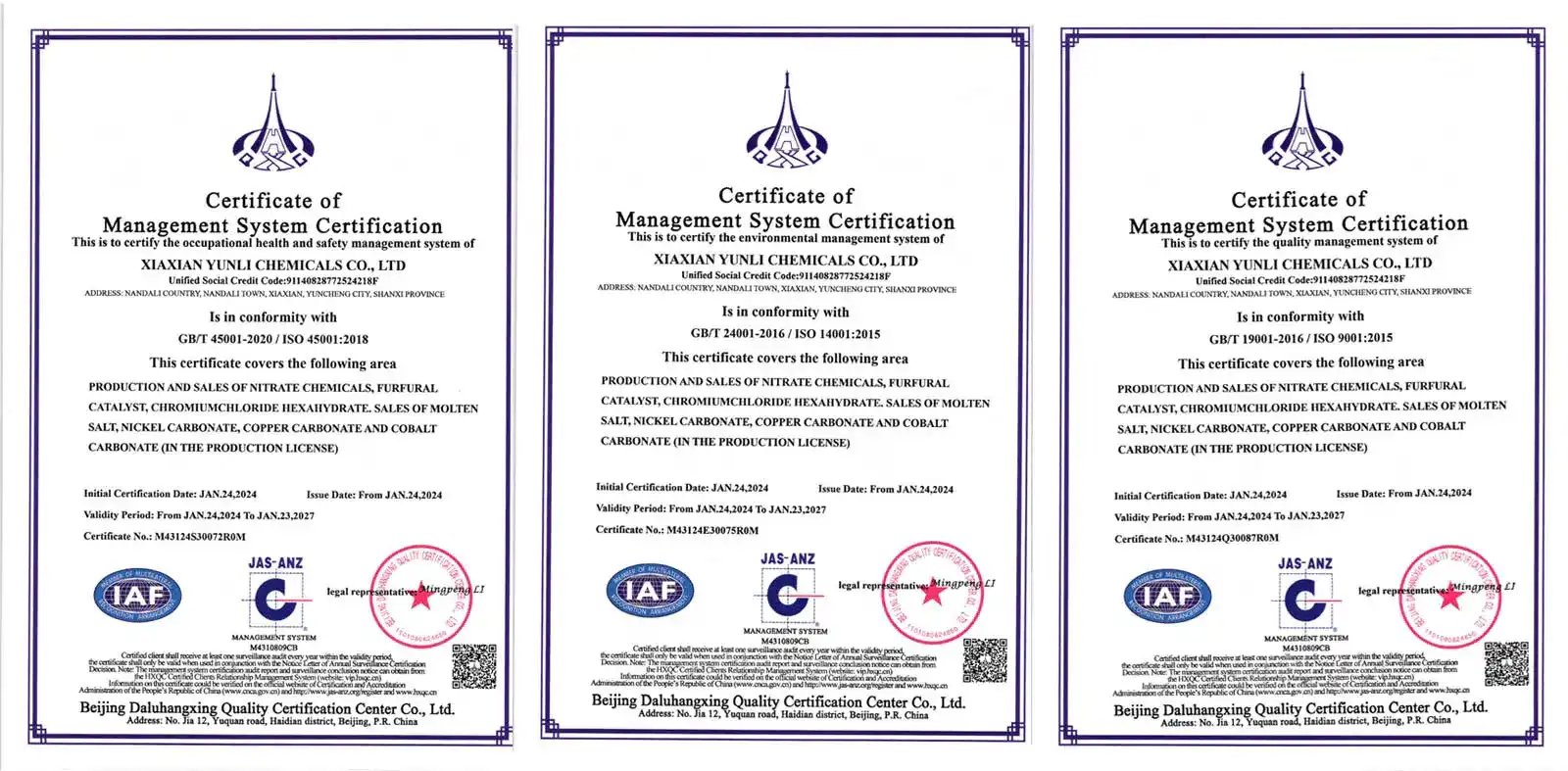
Third-party certifications and clear testing procedures are ways that reliable sellers show quality. ISO 9001 quality management systems make sure that processes are written down and can be tracked. ISO 14001 environmental standards prove that production methods are sustainable. OHSAS workplace health standards protect the safety of workers, which indirectly ensures product consistency through strict operating discipline.
All three licenses belong to Yunli Chemical, and they are regularly checked by foreign groups. Each batch of production goes through strict tests to check its cleanliness, moisture content, pH, and impurity profiles. Every package comes with a Certificate of Analysis (COA), which has information about each lot that helps the customer's quality control processes. Documentation that shows compliance with REACH and RoHS makes it easier to bring goods into European and North American markets, which is very important for wholesalers who work in more than one area.
Logistics and Minimum Order Quantities
Transportation of Chromium Nitrate is controlled by rules for dangerous materials. When you package things correctly, they stay dry and clean during transport. Yunli Chemical has a variety of flexible packing choices, such as moisture-resistant polyethylene bags for smaller amounts, fiber drums for medium-sized amounts, and IBC tanks for large amounts of liquid solutions. Custom labeling meets the needs of regional language and danger information, which makes storage and handling easier at the final location.
Minimum order numbers (MOQ) make sure that production is efficient and customers can get what they need. Our 1000kg MOQ is good for medium to large businesses that want to buy a lot of goods or make regular purchases. We also offer sample programs for people who want to place trial orders. During the testing stages, no-minimum order quantity rules apply to unique custom formulas. Standard grades take about two to three weeks to deliver, but there are faster choices for those who need them right away. When a plant exports directly, there are no markups by agents. This saves buyers money and keeps communication lines open.
Practical Guide: How to Handle and Store Chromium Nitrate Safely?
Hazard Management Rooted in Chemical Properties
Because Chromium Nitrate oxidizes, it needs to be kept away from things that can catch fire, organic solvents, and reducing agents while it is being stored. People who work with the compound need to wear chemical-resistant gloves, safety goggles, and protective clothes to keep their skin and eyes from coming into touch with the chemical. When there is a spill, neutralization procedures use weak sodium carbonate solutions to change volatile nitrate into less dangerous carbonates that can then be thrown away.
Plans for how to handle emergencies should include fire scenarios. Chromium Nitrate doesn't burn itself, but when it breaks down at high temperatures, it releases oxygen that makes close things burn faster. Fire control uses water spray or foam to cool containers and stop them from breaking down too quickly. Operators are taught to spot early warning signs, like changes in color, strange burning, or gas evolution, that mean something is wrong and needs to be fixed right away.
Best Practices for Storage and Preservation
Controlled conditions are needed to keep the purity of the product. To stop deliquescence and caking, storage places should keep the temperature between 15°C and 25°C and the relative humidity below 50%. For smaller amounts, sealed cases made of suitable materials like high-density polyethylene or glass work well. For large storing, steel with the right coatings keeps out moisture and contamination. First-in, first-out (FIFO) rules are used to rotate inventory so that it doesn't go bad too quickly. However, Chromium Nitrate stays safe for 24 months when kept properly.
Safety gaps are built into warehouse plans. Chromium Nitrate storing areas keep a minimum distance from things that can catch fire, acids that could make heat when mixed, and chemicals that don't mix with Chromium Nitrate, such as ammonia or sulfides. Ventilation systems move enough air around to get rid of any vapors that might get in. Spill control systems catch material that leaks out and keep the surroundings from getting dirty. The Occupational Safety and Health Administration (OSHA) and local fire rules say that these steps are necessary to protect workers and the people who live nearby.
Real-World Safety Implementation in Industrial Settings
Manufacturing sites in the cloth, electroplating, and catalyst production businesses have successfully used Chromium Nitrate by making safety rules part of their daily work. One company that makes car parts switched from chromium chloride to Chromium Nitrate in their passivation line. This stopped rust caused by chloride and made the workplace safer by lowering the exposure to volatile compounds. As part of their transition, they retrained operators on the risks that come with nitrates, upgraded their spill response tools, and changed the way they treated waste. These were all investments that paid off because there were no safety issues in the three years they were in business.
Chromium Nitrate's clean breakdown profile during calcination is good for companies that make catalysts. A petrochemical business that makes polymerization catalysts said that their products last 15% longer after moving from sulfate-based precursors to our nitrate product. The lack of sulfur pollution kept active sites for longer, which cut down on the number of times the catalyst had to be replaced and the costs that came with that. Proper keeping in climate-controlled buildings and automatic dosing systems kept people from having to touch the drugs as little as possible, which improved safety even more.
Conclusion
Figuring out whether Chromium Nitrate forms ionic or covalent bonds has a direct effect on how it is used in industry and how it is bought. The mostly ionic nature of chromium cations and nitrate anions makes them easily soluble, electrically conductive in solution, and easy to predict in their decomposition paths. These are important qualities for making catalysts, treating surfaces, and stopping rust. At the same time, covalent bonds within nitrate groups keeps the structure stable and allows for clean heat breakdown.
Compared to chromium chloride and sulfate options, Chromium Nitrate has a halide- and sulfate-free chemistry that saves equipment, extends the life of catalysts, and makes it easier to follow the rules. Purchasing managers should choose providers like Yunli Chemical because they have been making chemicals for 20 years, have strict quality control, and have many certifications that lower supply chain risks. Chemical bonding knowledge-based safe handling and storage practices protect workers and keep product quality high, allowing for trusting long-term relationships.
FAQ
Q1: What makes chromium nitrate safer than hexavalent chromium compounds?
A: Chromium Nitrate contains trivalent chromium (Cr³⁺), which is much less harmful and likely to cause cancer than hexavalent chromium (Cr⁶⁺). Regulatory bodies around the world limit Cr⁶⁺ because it is harmful to health. However, Cr³⁺ can still be used in industry as long as it is handled properly. Because of this difference, producers can protect against rust and improve catalytic performance without putting workers at risk of toxic exposure.
Q2: Can chromium nitrate replace chromium chloride in all applications?
A: Chromium Nitrate works well as a replacement in most surface cleaning and catalyst processes, providing better results by stopping corrosion caused by chloride. But for some specific uses that need specific chloride chemistry, the recipe may need to be changed. Talking to technical experts, like the ones at Yunli Chemical, can help you find the best replacement methods for your process.
Q3: How does bonding type affect chromium nitrate's shelf life?
A: Ionic bonding makes Chromium Nitrate hygroscopic, which means it takes in water from the air. This can lead to caking and a loss of quality. If you store food properly in covered, water-resistant cases with controlled humidity, it will last up to 24 months. Under normal storing conditions, the covalent security of the nitrate ions stops them from breaking down on their own.
Q4: Why choose Yunli Chemical as your chromium nitrate supplier?
A: Yunli Chemical blends large-scale production with high-level technology. Our provincial technology center lets us customize purity levels (98–99.9%), pH ranges, and package types that aren't available from common providers. Getting government approvals is easier when you have ISO certifications, full MSDS paperwork, and REACH/RoHS compliance. With yearly sales of RMB 1 billion and 20 years of experience, we offer supply security that is important for planning long-term production. With factory-direct pricing, there are no markups for distributors. This makes prices more affordable without lowering quality.
Partner with a Trusted Chromium Nitrate Manufacturer
Sourcing high-purity Chromium Nitrate requires more than competitive pricing—it demands a supplier who understands the chemical intricacies that drive your production outcomes. Yunli Chemical stands as China's leading Chromium Nitrate manufacturer, delivering ultra-low impurity products (Fe ≤30ppm) with customizable specifications that meet the demanding requirements of catalyst manufacturing, electroplating, and specialty chemical synthesis. Our provincial-level technology center and advanced analytical capabilities—including ICP-MS and atomic absorption spectrometry—ensure batch-to-batch consistency that minimizes process variation.
With over 20 years serving global manufacturers, we provide complete compliance documentation (MSDS, COA, environmental certifications) that simplifies regulatory approvals across multiple jurisdictions. Our flexible packaging options, from 25kg moisture-resistant bags to bulk IBC tanks, accommodate diverse logistical requirements. Direct factory export eliminates intermediary markups, while our free sample program (up to 500g) allows risk-free evaluation before bulk commitment.
Whether you're transitioning from hexavalent chromium to compliant trivalent alternatives, seeking halide-free catalyst precursors, or requiring pharmaceutical-grade purity for sensitive applications, our technical team collaborates to optimize formulations and solve production challenges. Contact Yunli Chemical at wangjuan202301@outlook.com to discuss your Chromium Nitrate requirements. Discover how our proven manufacturing excellence and customer-focused service deliver the supply stability and technical support your operations demand.

References
1. Cotton, F.A., and Wilkinson, G. (1988). Advanced Inorganic Chemistry, 5th Edition. New York: Wiley-Interscience.
2. Greenwood, N.N., and Earnshaw, A. (1997). Chemistry of the Elements, 2nd Edition. Oxford: Butterworth-Heinemann.
3. Pauling, L. (1960). The Nature of the Chemical Bond, 3rd Edition. Ithaca: Cornell University Press.
4. Housecroft, C.E., and Sharpe, A.G. (2012). Inorganic Chemistry, 4th Edition. Harlow: Pearson Education Limited.
5. ASTM International (2020). ASTM B117-19: Standard Practice for Operating Salt Spray (Fog) Apparatus. West Conshohocken: ASTM International.
6. European Chemicals Agency (2021). Guidance on the Application of the CLP Criteria: Guidance to Regulation (EC) No 1272/2008. Helsinki: ECHA Publications.







