





Is Iron Nitrate Suitable for Fertilizer and Agricultural Formulas?
Iron nitrate — chemically expressed as Fe(NO₃)₃·9H₂O — does have measurable agricultural relevance, though its primary commercial strength lies in industrial chemistry. As a highly water-soluble ferric compound, it can deliver bioavailable iron to iron-deficient soils and hydroponic systems. Compared to iron sulfate or ferrous gluconate, ferric nitrate releases iron rapidly into the root zone. However, its oxidizing properties and handling requirements make it a specialized input rather than a standard agronomic choice. Understanding when and how to use it correctly helps procurement specialists and formulators make confident, cost-effective decisions.
Understanding Iron Nitrate: Key Properties and Agricultural Relevance
In order to judge whether or not it can be used in fertilizer, it is helpful to know what this chemical is technically.
Chemical Identity and Physical Behavior
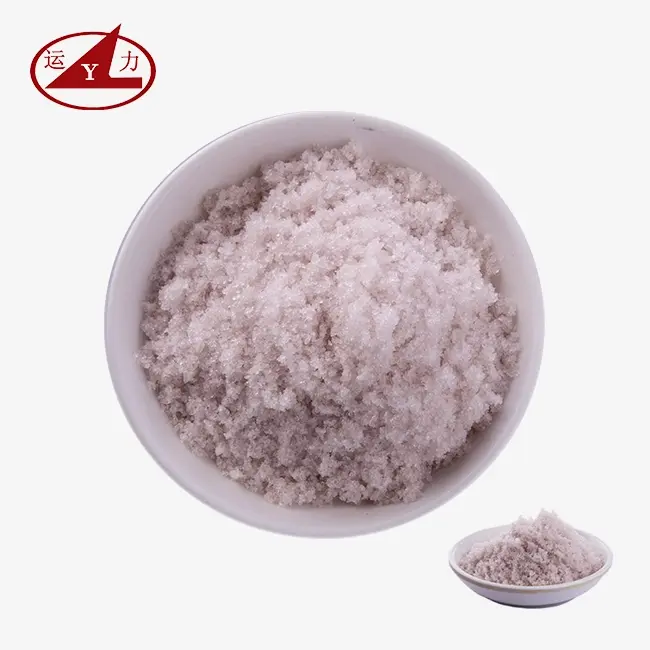
It is a purple-violet crystalline solid with a molecular weight of 404.01 g/mol and a freezing point of 47.2°C. Its CAS number is 7782-61-8. It breaks down at about 125°C and has a specific density of 1.68. The compound is strongly deliquescent, which means it easily takes moisture from the air. This has an impact on how stable it is in storage, how much packaging is needed, and how long it lasts. It doesn't react with water, ethanol, or acetone, so it can be used in a lot of different ways to make liquid fertilizer and nutrient solutions.
Why Iron Matters in Crop Nutrition?
Iron is a micronutrient that plants need to make chlorophyll, activate enzymes, and move electrons around inside their cells. Iron shortage, which can be seen as interveinal chlorosis on young leaves, makes photosynthesis less efficient, which lowers output. Alkaline and calcareous soils often make it hard for plants to get iron, which hurts crops like soy, rice, sorghum, and many types of plants used for gardening. This problem can be solved better with a soluble iron source that the plant can absorb quickly than with oxide forms that release iron slowly.
The molecular formula shows that iron nitrate has an iron content of about 13.8% by weight. This is less than ferrous sulfate's about 20%, but the better solubility and nitrate co-delivery make up for it in specific situations, like aerial sprays and drip-irrigation fertigation systems.
Iron Nitrate vs. Other Iron Sources in Agriculture: Choosing the Best Option
Not every iron fertilizer works the same way on all types of soil, with all crops, or when used in all ways. Before committing to large sales, procurement managers need to make a fair comparison.
Solubility and Bioavailability
For high-pH soils, iron chelates (EDDHA, EDTA) are still the best choice because they keep iron from precipitating. They do, however, come with a big price tag. Iron nitrate dissolves easily and doesn't cost too much. It works well in hydroponic nutrient solutions and acidic to neutral soils where chelation isn't as important. Even though ferrous sulfate is cheap and widely used, it can change the pH of the soil over time by adding sulfate anions.
Soil Acidification Risk
There is a big difference between iron nitrate and iron sources based on sulfate. Iron sulfate drops the pH of the earth over time, which is good for plants that like acidic conditions but could cause sensitive systems to lose nutrients. Because iron nitrate doesn't have this problem, it's a better choice for formulators who are in charge of multi-crop projects or who have to keep pH levels within strict limits in controlled-environment agriculture.
The nitrate co-ion also has a secondary nutritional role. Nitrogen is a macronutrient, and when it is present with iron, it can make some fertigation systems more efficient by reducing the need for extra nitrogen inputs.
Procurement Considerations: Buying Iron Nitrate for Agricultural Use
When looking for this substance on an industrial scale, you need to think about more than just price per kilogram. You also need to think about purity standards, transport, and the skills of the provider.
Purity Grades and Specification Requirements
Purity levels of at least 98% are usually needed for agricultural and specialty chemical uses. Thresholds for impurity are very important. Chloride levels that are too high (above 100 ppm) can hurt plants and rust irrigation systems. For use on food crops, heavy metals like lead, cadmium, and arsenic must stay below the ppb level. For serious formulators, it's a must to only buy from sources that can provide ICP-MS proof and written batch certificates.
Here are the main factors that should be compared between suppliers when making a purchase:
- Purity: ≥98% (Fe(NO₃)₃·9H₂O assay), and 99.9% can be provided upon request for precise uses.
- Chloride content: Standard chlorine level is 100 parts per million (ppm); for sensitive crop programs, 50 ppm is suggested.
- Heavy metals: Checked with ICP-OES or ICP-MS; very important for food safety regulations.
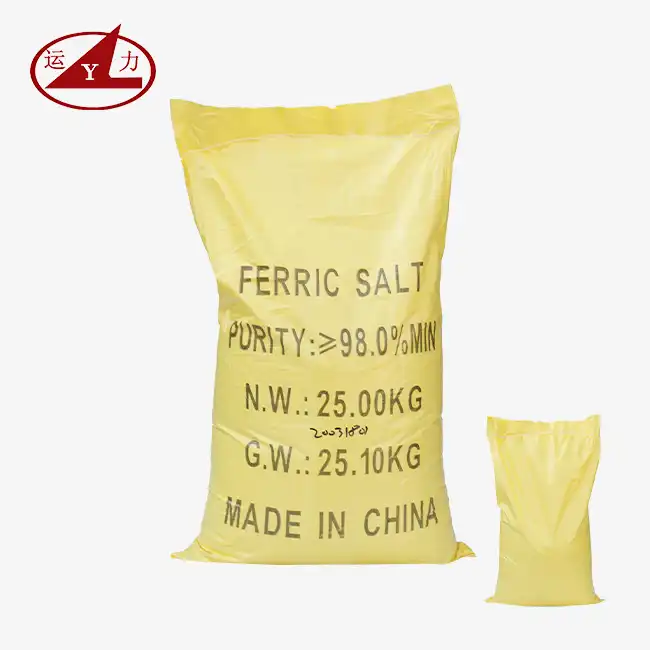
- Packaging integrity: 25 kg moisture-barrier PE bags or 500 kg sealed drums to keep the goods from going bad during transport.
- Anti-caking treatment: Special ingredients make the product last longer on the shelf in humid places.
Together, these factors decide whether a lot of iron nitrate works the same way in different production processes or causes expensive variations. When procurement teams lock in specification sheets before placing an order, they avoid having to pay extra to change the formula later on.
Handling and Transport Safety
Class 5.1 oxidizers are things like iron nitrate. It combines energetically with biological materials and needs to be kept cool, dry, and sealed away from things that can catch fire. Logistics that keep an eye on temperatures keep crystals from melting (melting point: 47.2°C) during shipping in the summer. Responsible suppliers offer SDS documents, labels that meet UN standards, and freight options that keep an eye on the temperature.
Application Best Practices: Integrating Iron Nitrate into Fertilizer Formulas
Hydroponic and Fertigation Systems
When the pH of the fluid stays between 5.5 and 6.5, iron nitrate dissolves completely in closed-loop hydroponics, leaving no leftover precipitate. Studies done in controlled greenhouses show that iron levels in nutrient solutions between 1 and 5 mg/L help plants grow in a healthy way without making the plants too toxic for iron. Crystalline inputs can sometimes cause dissolution lag, but pre-dissolved liquid formats don't have that problem. This makes dosing more accurate.
Foliar Application and Soil Drenches
Foliar sprays with a dose of 0.5 to 1% can quickly fix field crops that are showing signs of shortage. Drenching the soil works best when the soil is only slightly acidic. When formulators mix complex fertilizers, they need to make sure that the phosphate-containing parts are compatible. If mixing ratios and pH are not carefully controlled, iron-phosphate precipitation can lower bioavailability.
Respecting application rates is also part of responsible use. Too much iron can cause oxidative stress in plants that are sensitive to it, and it may also stop manganese and zinc from being absorbed through competition absorption routes.
Future Trends and Innovations in Iron-Based Fertilizers
The market for specialty micronutrient fertilizer is growing. A 2023 market study by MarketsandMarkets says that the global micronutrient fertilizer market will grow at a compound annual growth rate (CAGR) of 8.2% through 2028. This is because more people are using precise agriculture and learning about how to take care of their land. In this situation, water-soluble iron sources like iron nitrate are becoming more popular in controlled-environment farming, especially as vertical farming spreads around the world.
Nano-encapsulated iron delivery methods, pH-buffered liquid concentrates, and co-formulated iron-zinc-manganese blends made for single-pass fertigation are some new formulation trends. Suppliers that put money into research and development (R&D) are best able to meet these changing needs. This is especially true for those with provincial-level technology center accreditation and in-house analytical labs.
Conclusion
Although iron nitrate is not always a good addition to fertilizer, it can be very useful in certain situations, such as hydroponics, foliar correction, or precision fertigation. It is different from other iron sources because it dissolves easily, has two types of nutrients (iron and nitrogen), and doesn't change the pH of the earth. Buying decisions should be based on confirmed purity, a supplier's dependability, and the right infrastructure for handling. Iron nitrate has a place in advanced fertilizer recipes when these conditions are met.
FAQ
Is ferric nitrate safe to use on edible crops?
Iron nitrate can be used in farming programs that involve edible crops as long as the application rates are kept under control and the purity standards are food-grade (no heavy metals found above regulatory limits). Always check the batch papers from the seller and look at the local rules and regulations before applying.
How does iron nitrate differ from EDDHA iron chelate?
Iron chelates, such as EDDHA, keep iron soluble over a wider pH range, even in soils that are very alkaline. Iron nitrate is less expensive and works well in neutral to acidic environments or hydroponic systems. Most of the time, chelates cost 3–5× more per unit of iron they give.
What causes clumping during storage, and how do I prevent it?
Because the compound is deliquescent, it takes in water from the air, which makes the crystals fuse together. Caking can be avoided by storing items in tight, moisture-barrier packages below 25°C with desiccant inserts. Suppliers who directly add anti-caking agents to products make them last a lot longer before they can be used.
Can it be blended with other fertilizer components?
It can be mixed with most nitrogen and potassium sources, but it shouldn't be mixed immediately with strong phosphate solutions without controlling the pH, or iron-phosphate precipitation could happen.
Partner with Yunli Chemical — Your Trusted Iron Nitrate Supplier
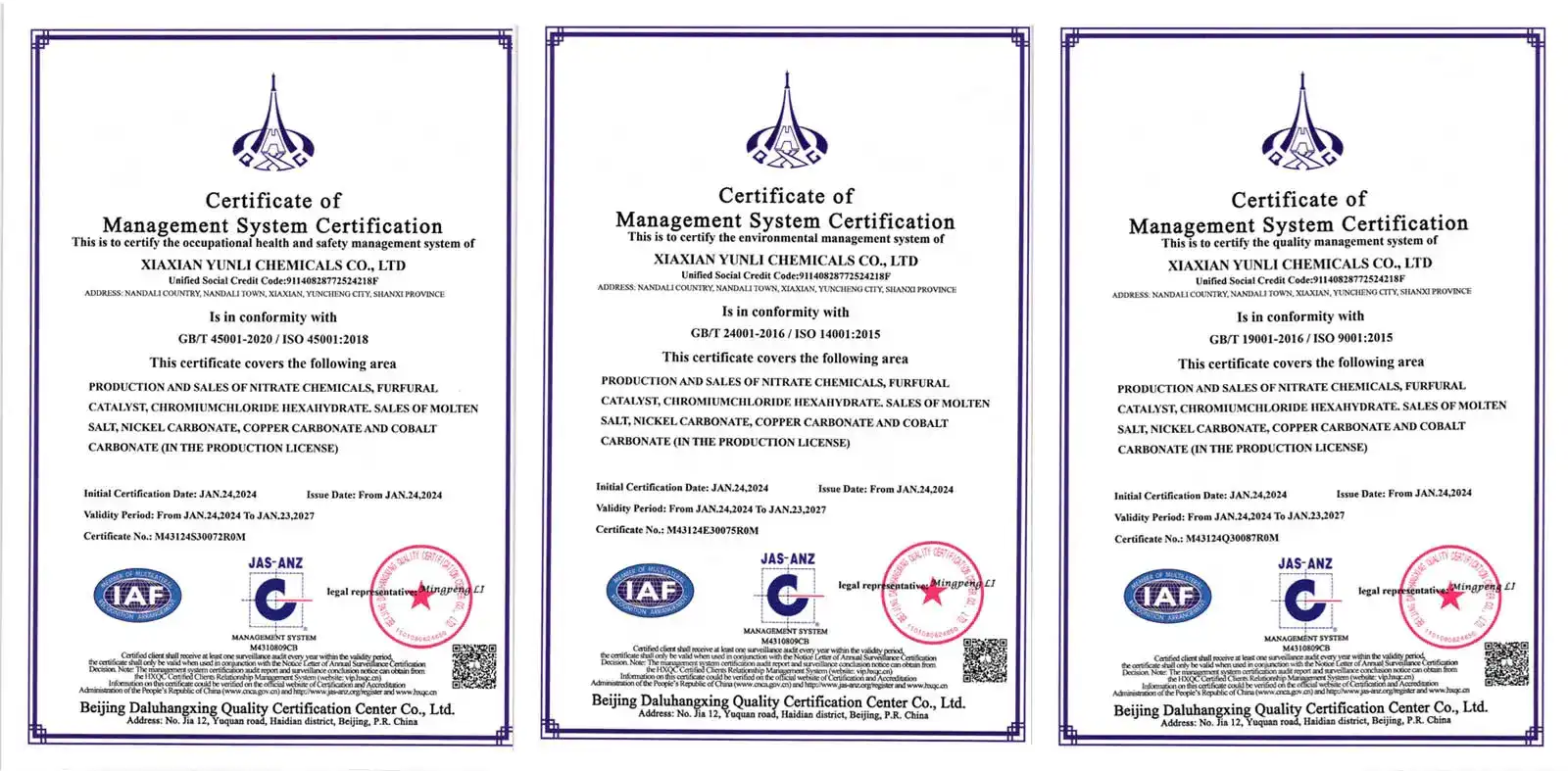
Since 2005, Yunli Chemical has been selling verified-grade iron nitrate (Fe(NO₃)₃·9H₂O, ≥98% purity, CAS 7782-61-8) to companies around the world. Custom crystal sizing, pre-dissolved liquid solutions, anti-caking formulas, and ICP-MS-backed batch certificates are some of the things that our iron nitrate maker can do. There is no MOQ. Try it for free up to 500 g. To get a price right away, email our expert team at wangjuan202301@outlook.com.
References
1. Broadley, M. R., & White, P. J. (Eds.). Plant Nutritional Genomics. Blackwell Publishing, 2005.
2. Lindsay, W. L., & Schwab, A. P. "The Chemistry of Iron in Soils and Its Availability to Plants." Journal of Plant Nutrition, 1982.
3. Römheld, V., & Marschner, H. "Evidence for a Specific Uptake System for Iron Phytosiderophores in Roots of Grasses." Plant Physiology, 1986.
4. MarketsandMarkets. Micronutrient Fertilizers Market — Global Forecast to 2028. MarketsandMarkets Research, 2023.
5. Abadía, J., et al. "Foliar Iron Fertilization of Fruit Trees: A Critical Review." Journal of Plant Physiology, 2011.
6. Lucena, J. J. "Iron Chelates for Remediation of Iron Chlorosis in Strategy I Plants." Journal of Plant Nutrition, 2000.







