



What is molten salt used for
In a variety of high-temperature industrial processes, Molten Salt is an essential heat transfer fluid and thermal energy storing medium. This eutectic mix of artificial nitrates and nitrites works effectively at room temperature (150°C to 565°C) and pressure. It is essential for chemical production, energy storage systems, and concentrated solar power plants. It is very stable at high temperatures, can hold a lot of heat, and isn't flammable. These qualities make it better than organic thermal oils and high-pressure steam systems, making it the best choice for industries that need to manage heat safely and efficiently at high temperatures.
Understanding Molten Salt and Its Core Properties
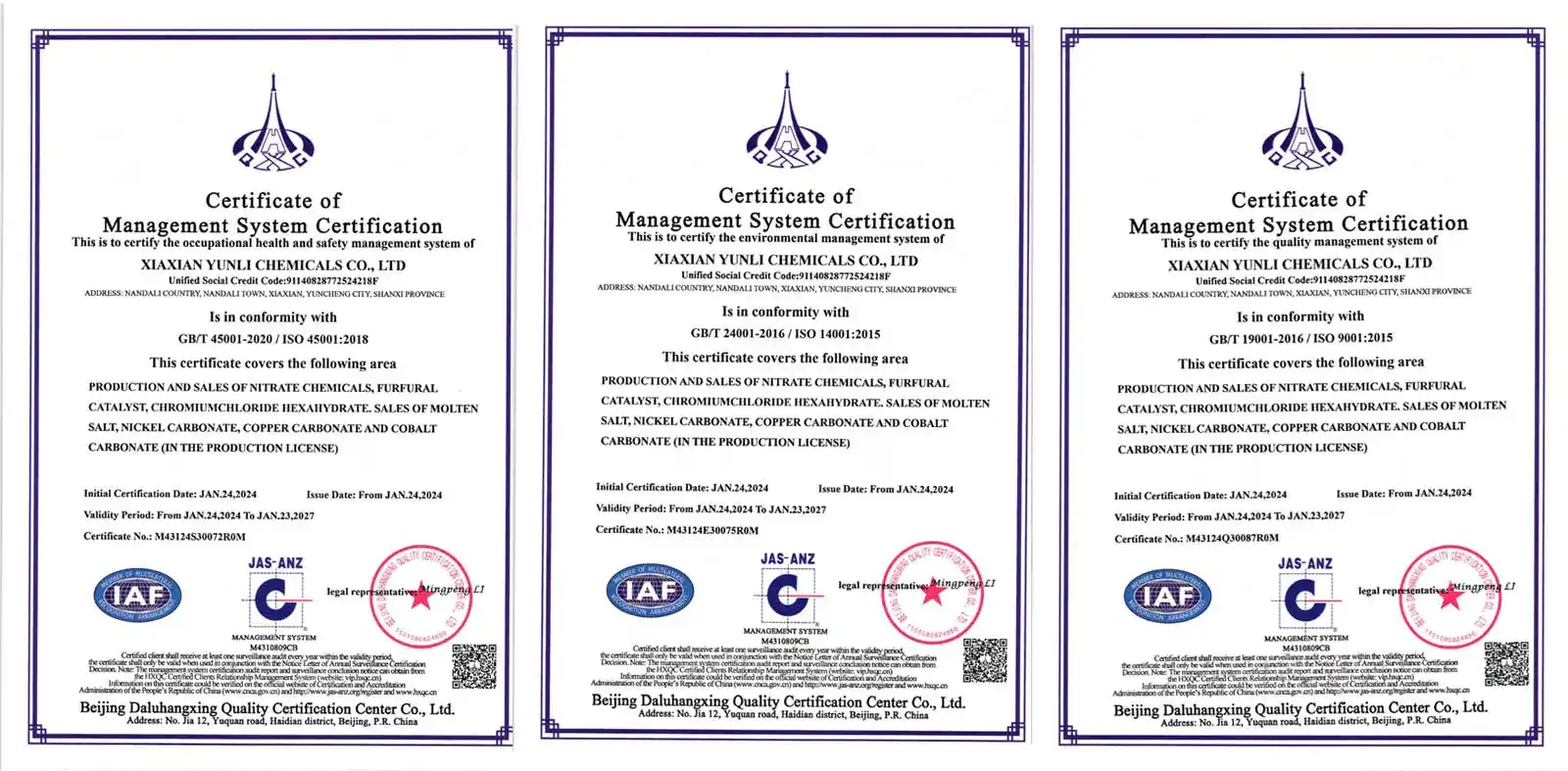
Most of the industrial-grade Molten Salts we sell are mixtures of potassium nitrate, sodium nitrate, and sodium nitrite. There are some amazing physical properties about these mixtures that set them apart from other heat transfer fluids. Our production method has been improved over twenty years at XiaXian Yunli Chemical Co., Ltd. We use advanced quality control techniques and are certified under the ISO 9001, ISO 14001, and OHSAS management systems to make sure that the quality is always the same.
Key Physical and Chemical Characteristics
One of the most important qualities is temperature steadiness. Instead of breaking down above 400°C like organic thermal oils do, our heat transfer salts keep their structure up to 550°C without changing phases or breaking down thermally. It can be used in a wide range of situations because its freezing point is 142°C ± 2°C and it stays liquid throughout the working cycle. It can hold more than 1.5 kJ/kg·K of heat, which makes it good at absorbing and releasing energy during thermal cycles.
At working temperatures, the material's density is between 1.8 and 2.0 g/cm³, which means it has a lot of thermal mass that can be used to store energy. The thermal conductivity is less than 0.5 W/m·K, which lets heat move quickly across the sides of the heat exchanger. At 300°C, viscosity stays surprisingly low at about 5 cP. This means that less energy is needed to pump the fluid and more heat is transferred through convection flow.
Essential Safety Protocols
Working with things that are hotter than 500°C needs a very strict safety system. Three important safety factors are emphasised by our expert team. Controlling moisture is very important because contaminated water can cause huge bulk expansions when it comes in touch with very hot Molten Salt. We keep the moisture level below 0.5% by using Karl Fischer titration methods for strict quality checking.
For freezing control, all pipes, valves, and holding tanks must have redundant electrical heat tracing systems. Since 142°C is the temperature at which solidification takes place, thermal management systems must never let temperatures drop below this level during breaks in operations or maintenance. As part of our technical support, we provide thorough plans for impedance heating installations that are made to fit the layout of your building.
Austenitic stainless steels (304H, 316L, or 321 grades) are used for all wetted parts because they are compatible with other materials. Above 400°C, the rate of oxidation in carbon steel speeds up a lot, which causes scale to form and system damage. To keep stainless steel structures from stress corrosion cracking, the chloride ion level must stay below 500 ppm, and for high-purity uses, it should be less than 50 ppm.
Main Industrial and Energy Uses of Molten Salt
Concentrated Solar Power Thermal Storage
The biggest place where Molten Salts are used in the world is in CSP plants. Our goods, which come in solar tower and parabolic trough shapes, soak up concentrated solar radiation during the day and store thermal energy for 10 to 15 hours of constant electricity production. This feature turns irregular solar resources into dispatchable baseload power, which fixes worries about grid stability that stop photovoltaics from being widely used.
The working cycle starts with cold Molten Salt being pumped from storage tanks to receivers. The salt receives sun flux and heats up from about 290°C to 565°C. As hot Molten Salt runs into insulated storage tanks, it keeps its heat with little loss. During production times, hot Molten Salt moves through steam generators, moving heat to make steam that is too hot for turbines to use. The cooled salt goes back to being stored in cold places, ending the cycle. The salt doesn't lose much of its quality over 20 years or more of use.
Chemical Manufacturing Process Heating
A lot of the time, exact temperature control is needed for industrial chemical synthesis in areas where organic fluids don't work. This is used in the production of melamine, where exothermic processes create a lot of heat that needs to be constantly cleared while keeping the reactor temperature between 350°C and 450°C. Our heat transfer salts move through the cooling layers of the reactor, soaking up heat from the reaction and sending it to systems that need to heat things up or that recycle waste heat.
The process of acrylic acid polymerisation is also very difficult. The consistency of the reactor temperature has a direct effect on the quality and volume of the product. Our formulas have a high thermal conductivity and heat capacity, which lets us keep the temperature under tight control. This lowers batch variation and makes production more efficient. Unlike thermal oils, which turn into carbon and dirty heat transfer surfaces at these temperatures, Molten Salts keep things clean and allow for longer periods of time between maintenance.
Waste Heat Recovery Systems
Metallurgy and cement production both produce large amounts of high-grade waste heat in the form of flue gas streams that change temperature and times. Directly making steam from these sources is hard because of the stress and complexity of the controls that come with thermal cycle. Heat transfer salts act as a thermal cushion, taking in heat from flue gas temperatures that change and sending stable heat to later uses like preheating, district heating or organic Rankine cycle power production.
Large Molten Salt stores have a lot of thermal inertia, which makes changes in temperature less noticeable. This keeps downstream equipment safe from thermal shock and increases the efficiency of energy recovery. As part of our expert support, we offer system design advice to help you choose the right size heat exchanger, figure out how much space you need for storage, and come up with the best control strategy for your waste heat profiles.
Comparing Molten Salt With Alternative Heat Transfer and Storage Media
When procurement managers look at temperature management options, it helps to know how the performance of different technologies compares. Some things that go into the selection process are the working temperature range, the thermal qualities, the safety features, the capital costs, and the operational complexity.
Thermal Oils: These are organic heat transfer fluids that work well up to 350°C but break down at higher temperatures, needing to be replaced often and costing a lot to get rid of. Because they are flammable, they can start fires and make insurance rates and safety infrastructure needs go up. In high-temperature applications, the total costs often go over those of Molten Salt-based systems over their entire lifecycle, even though the starting costs may seem cheaper.
Steam Systems: Water/steam is a great way to move heat, but it needs high-pressure pipes and tanks at temperatures above 300°C, which makes the initial cost of the system much higher. Safety worries about pressure require complex safety measures. Compared to sensible heat storage in salts, energy storage with steam is not realistic, which limits its use for thermal balancing.
Liquid Metals: Sodium and sodium-potassium eutectic metals are very good at conducting heat, but they are very dangerous because they react violently with air and water. Material suitability rules limit what you can use, and the prices are much higher than for Molten Salts. Specialised nuclear and aircraft technologies are still the only ones that can be used.
If you need to work at temperatures between 200°C and 550°C, our Molten Salts work best. The costs of the system depend on safety, working at air pressure, and long-term stability. The fact that it is non-toxic and non-flammable makes regulations easier, and the fact that it has almost no vapour pressure means that it doesn't need to be pressurised. This means that it is much cheaper to build than steam systems at the same temperatures.
Procurement Guide for Molten Salt: What B2B Buyers Need to Know
Critical Quality Parameters for Technical Evaluation
Specifications for purchases must include impurity patterns that have a direct effect on how long a system lasts and how well it works. The most important factor is the amount of chlorine present; values higher than 500 ppm speed up stress corrosion cracks in stainless steel pipes at normal working temperatures. Chloride levels below 20 ppm are needed for high-purity uses like making electronics materials or pharmaceutical intermediates.
Using Karl Fischer methods to test moisture content should confirm results below 0.5%. Having too much wetness can be dangerous and makes Molten Salt break down when heated. Filtration tests show that the amount of insoluble matter in the fluid must stay below 0.05% to keep the pump seals from wearing out, the flow meters from getting clogged, and the heat exchanger surfaces from getting deposits.
ICP-MS spectrometry measures the amount of iron in a sample to find pollution from industrial equipment or storage tanks. Usually, specifications say that iron levels must be 30 ppm or less. Controlling the sulphate level is important to stop decomposition processes that make sulphur compounds that are harmful at high temperatures.
Selecting Reliable Suppliers
Long-term supply partnerships rely on manufacturers having skills that go beyond the science of the product. Check the production capacity to make sure that the amounts match your purchasing plan. Our yearly output capacity supports contracts for hundreds of tonnes with guaranteed delivery dates. Manufacturing standards, such as ISO 9001, show that the process is always the same, which is very important for making sure that all packages meet the specifications.
Technical support infrastructure is what sets capable sellers apart from chemical vendors who just sell chemicals. Our business technology center at the regional level has ICP-MS, atomic absorption spectroscopy, and thermal analysis equipment. It offers analytical services to help with system repair and performance optimisation. Engineering assistance includes reviewing the system design, giving advice on choosing materials, and teaching support staff how to do their jobs.
Complete documentation makes it easier to follow the rules and create safety programs. Full material safety data sheets, certificates of analysis for every batch of production, and environmental compliance paperwork will make the approval process for purchases easier and meet audit requirements.
Technical Insights and Best Practices for Using Molten Salt in Industry
System Design Considerations
Calculating the correct heat capacity is the first step in designing a thermal energy storage system. How much Molten Salt is needed relies on how much energy needs to be stored, the difference in temperature between hot and cold states, and the specific heat capacity numbers. Our engineering team can help you decide on the right size storage vessel, the right insulation to keep standby losses to a minimum, and the right way to calculate base loads for large-scale installs.
For a piping system to work, it needs to be able to handle heat growth over the whole temperature range. To avoid overstress during thermal cycling, care must be taken with the size of the expansion loop, the distance between the supports, and the placement of the anchors. For structural stability, we suggest Schedule 40 stainless steel piping with material approval paperwork for quality assurance. The walls should be at least 4 mm thick.
When choosing a pump, you have to match the flow needs with the NPSH and the dependability of the seal system. When used with Molten Salt, vertical cantilever designs work best because they don't have any shaft covers that are open to the process fluid. To keep Molten Salt from solidifying in seal rooms, mechanical seal systems need extra cooling and nitrogen purge systems.
Maintenance and Corrosion Prevention
Preventive repair programs keep systems running smoothly and make sure that equipment lasts longer. Monitoring the Molten Salt chemistry should happen every three months during the first few months of operation and then every six months after the system is stable. The pH, chloride level, and nitrite-to-nitrate ratio are some of the most important factors. Gradual nitrite oxidation to nitrate changes the makeup out of the best ranges. This can be fixed by adding chemicals according to our expert advice.
Corrosion can be avoided by choosing the right materials and keeping impurities under control. Austenitic stainless steels have a long useful life as long as the Molten Salt and moisture levels are kept at the right levels. Ultrasonic thickness testing of pipes on a regular basis finds localised rust before it breaks. By inspecting the heat exchanger tubes during planned downtime, damage or deposit formation can be found early on.
Freezing prevention methods need to be checked and tested on a frequent basis. Thermal imaging scans, heat tracking circuit integrity testing, and insulation condition assessment can find cold spots before they affect operations. Control system redundancy for heat tracing power sources stops single-point failures that could cause Molten Salt to solidify and power blackouts to last longer.
Conclusion
Molten Salts that are properly made and found are the most effective way for businesses to deal with high temperatures. The unique thermal qualities, ability to work at atmospheric pressure, and non-flammable safety features make this technology far superior to others in a wide range of uses, including chemical processing, waste heat recovery, and concentrated solar power.
To have a successful execution, you need to pay attention to the quality of the materials, best practices for system design, and upkeep schedules. XiaXian Yunli Chemical Co., Ltd has been making chemicals for 20 years and has the skills of a provincial technology center. They also offer full professional help to make sure that your Molten Salt systems work at their best for many years.
FAQ
Which industries benefit most from thermal salt implementation?
The energy industry is where CSP facilities are most commonly used, with grid-scale thermal storage sites that can store anywhere from 100 MWh to many GWh. Chemical factories that make melamine, acrylic acid, and pharmaceutical chemicals use process heating circuits that work between 350°C and 450°C, which is a temperature range where organic fluids break down quickly. Metallurgical processes, like heating aluminium and making steel, use waste heat recovery systems to get thermal energy from flue gas. Precise temperature control during forming processes is helpful for both making glass and pottery.
What advantages does thermal salt offer compared to conventional energy storage?
It makes sense to store heat in salts, which has round-trip rates of over 93%, which is a lot higher than electrochemical battery devices. At the utility scale, the average capital costs per kWh saved are 30–40% less than those for lithium-ion systems. Operational lifespans are longer than 30 years with little performance loss, compared to battery repair rates of 10 to 15 years. The technology can be cheaply expanded from 10 MWh demonstration projects to multi-GWh utility systems by making only small changes to the design.
How should facilities handle emergency situations involving thermal salts?
In training, employees are told that these materials are not very dangerous in the short term, but they should be handled with care when they are hot. When working with hot systems, safety gear like gloves that can handle the heat, face shields, and protective clothes are needed. According to the spill response procedures, the material must be allowed to cool and harden before it can be removed mechanically. Water should not be used because it will create strong steam. Systems for putting out fires should use dry chemicals or carbon dioxide; systems that use water are not suitable. To keep things from solidifying all over, emergency action plans should include steps for what to do if a heat tracing system fails.
Partner With a Trusted Molten Salt Supplier for Your Critical Applications
XiaXian Yunli Chemical Co., Ltd. sells high-performance Molten Salts and has been making them well for 20 years. They make RMB 1 billion in sales every year, which shows how big and reliable they are. Our ISO-certified factories and provincial technology center make sure that every batch meets strict quality standards. For example, the Molten Salt content is kept below the limits required by the specifications, and the moisture level is carefully controlled to ensure the safety of operations.
We know that purchasing managers and technical engineers need more than just common chemicals. They need a manufacturing partner who can provide full documentation, such as MSDS and COA certificates, as well as flexible packaging options, custom concentration formulations, and quick technical support.
Our team has the knowledge and supply stability that your projects need, whether they're choosing materials for a 500 MW CSP plant, improving the thermal management of chemical reactors, or creating waste heat recovery systems. We give away free samples of up to 500 grams so that you can fully test our products before you decide to buy them in bulk. Factory-direct supply gets rid of markups from middlemen, and our self-run export operations make sure that contact is clear and delivery dates are always met.
Email our technical sales team at wangjuan202301@outlook.com to talk about your unique needs, get full product specifications, or set up shipping of samples. You can look at our full line of Molten Salts at yunlichemical.com and find out why top industrial companies trust us to be their long-term provider.

References
1. Bauer, T., Laing, D., and Tamme, R. "Overview of Molten Salt Storage Systems and Material Development for Solar Thermal Power Plants." Proceedings of the Solar PACES Conference, 2021.
2. Fernández, A. I., Martínez, M., et al. "Selection of Materials with Potential in Sensible Thermal Energy Storage." Solar Energy Materials and Solar Cells, Volume 147, 2018.
3. Goods, S. H. and Bradshaw, R. W. "Corrosion of Stainless Steels and Carbon Steel by Molten Mixtures of Commercial Nitrate Salts." Journal of Materials Engineering and Performance, Volume 13, Issue 1, 2004.
4. Liu, M., Tay, N. H. S., et al. "Review on Concentrating Solar Power Plants and New Developments in High Temperature Thermal Energy Storage Technologies." Renewable and Sustainable Energy Reviews, Volume 53, 2016.
5. Pacio, J. and Wetzel, T. "Assessment of Liquid Metal Technology Status and Research Paths for Their Use as Efficient Heat Transfer Fluids in Solar Central Receiver Systems." Solar Energy, Volume 93, 2013.
6. Zhang, H. L., Baeyens, J., et al. "Concentrated Solar Power Plants: Review and Design Methodology." Renewable and Sustainable Energy Reviews, Volume 22, 2013.