


What type of bond is copper nitrate trihydrate?
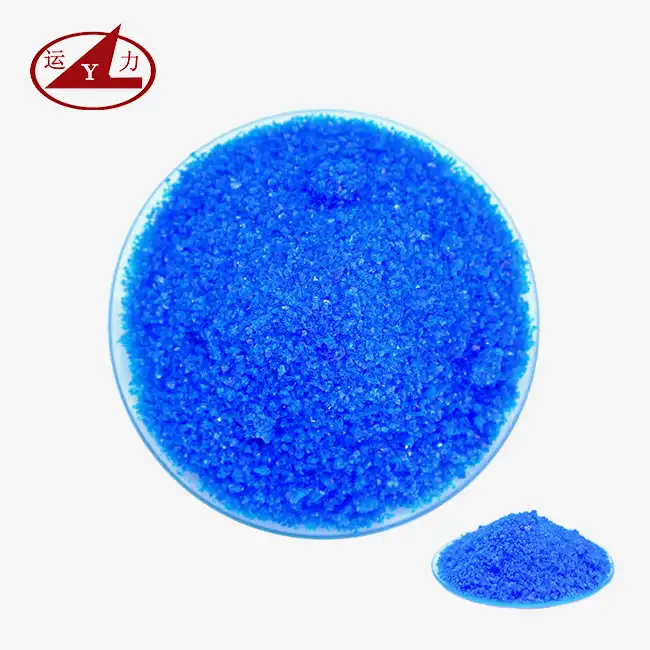
Ionic, coordinate covalent, and hydrogen bonds are all present in Copper Nitrate Trihydrate (Cu(NO₃)₂·3H₂O)'s complicated structural structure. Two nitrate anions form ionic bonds with the copper ion, and three water molecules connect through coordinate covalent bonds and hydrogen bonds. This special molecular structure explains why the substance has a dark blue solid look, dissolves easily in water, and absorbs water. These properties have a direct effect on how it is handled and used in industry.
Understanding the Chemical Structure of Copper Nitrate Trihydrate
The chemical structure of this coordination molecule shows why Copper Nitrate Trihydrate works so well in a wide range of industrial settings. At the center is a copper(II) ion that is ionically linked to two nitrate groups. This forms the main salt structure. The positively charged copper ions and negatively charged nitrate ions attract each other through electrostatic forces.
The Role of Ionic Bonds
Cu²⁺ and NO₃⁻ are held together by ionic bonds, which make the combination stable. This kind of bond is made when electrons are transferred, making charged particles that strongly attract each other. The compound's freezing point of 114.5°C and how it reacts in chemical processes are both based on how strong these ionic interactions are.
Coordinate Covalent Bonding with Water Molecules
Coordinate covalent bonds hold three water molecules to the copper center. The oxygen atom gives two electron pairs to the copper ion's empty orbitals. This arrangement explains the name "trihydrate" and is a big part of what makes the substance stable, soluble, and colored the way it is. When purchasing managers look at product specs, this water structure helps them understand why it's important to keep moisture levels low during storage.
Hydrogen Bonding in the Crystal Lattice
The water molecules are also part of networks of hydrogen bonds that run through the crystal structure. These bonds make the solid form even more stable. These weaker interactions explain why the substance easily absorbs water from the air and why it's important to package the product properly in airtight cases to keep its integrity while it's being shipped and stored. At Yunli Chemical, we carefully control the crystallization conditions to keep the hydration levels stable. This makes dark blue columnar crystals with a specific density of 2.05. This focus on structural regularity directly leads to expected performance when broken down in industrial processes.
Chemical Properties and Industrial Relevance of Copper Nitrate Trihydrate Bonds
This coordination compound's behavior in industrial settings is controlled by the types of bonds it has. Technical experts and procurement specialists can predict performance outcomes and improve application processes by understanding how Copper Nitrate Trihydrate bonds function in various environments.
Solubility Characteristics Driven by Bond Polarity
Because it is ionic and can form hydrogen bonds, this substance dissolves very easily in water—137.8 g dissolves in 100 mL at 0°C. This amazing ability to dissolve comes from the ionic parts working well with the polar water molecules, which make it easy to break up the crystal structure. The substance also dissolves easily in ethanol, which makes it more useful in organic synthesis tasks where water isn't an option. When the solution is mixed, it becomes acidic, with a pH of about 4.0. This is because the copper ion is involved in hydrolysis processes. This acidity affects how well it works as a mordant in dying textiles and as a catalyst in making chemicals.
Thermal Decomposition Patterns
First, heating breaks the coordinate bonds, which lets water molecules escape around 26°C to make dry copper nitrate. When heated over and over to 170°C, the ionic structure completely breaks down, releasing gases like copper oxide and nitrogen oxide. The chemical is useful as a catalyst precursor when controlled conversion to CuO is needed because of its reliable way of breaking down. Our factory uses thermogravimetric analysis (TGA) to keep a close eye on quality. This makes sure that the catalyst is in the exact trihydrate form needed for stoichiometric formulas. Changing the hydration level can change the copper content amounts, which could mess up formulas further down the line.
Oxidizing Properties and Safety Considerations
Strong electrical bonds exist between copper and nitrate ions, which makes them very good at reacting. This trait can be used in chemical production, but it needs to be handled carefully. The combination can start a fire or explosion when heated, rubbed, or hit against things that can catch fire. The nitrogen oxide fumes that are released are dangerous to your lungs, so factories need to have good venting systems. Every package from Yunli Chemical comes with full MSDS paperwork and a certificate of analysis (COA). This meets the environmental compliance requirements that are very important for procurement managers in the US. Our ISO 14001 license shows that we follow safe working rules all along the supply chain.
Comparison of Copper Nitrate Trihydrate with Related Compounds
When making a purchase choice, it's helpful to know how Copper Nitrate Trihydrate varies from other options in terms of cost, performance, and bonding structure.
Copper Nitrate Anhydrous vs. Trihydrate
The dry form doesn't have any ordered water molecules, so it behaves differently and dissolves in different ways. The dry version is often less stable during storage because it doesn't have any hydrogen bonding networks to keep the crystal structure steady. The trihydrate form is better for uses that need a uniform solution because it stays stable longer on the shelf and dissolves more easily. The dry form, on the other hand, has more copper when the highest quantity per unit mass is needed.
Copper Sulfate Pentahydrate Comparison
A popular option is copper sulfate, which has sulfate anions instead of nitrate groups. This substitution changes the compound's qualities in a basic way. Concerns about pollution are raised by sulfate ions in situations where sulfur affects the activity of catalysts or the quality of the product. The nitrate form breaks down more easily into copper oxide and sulfur, which makes it better for use as a catalyst in electronics and as an ingredient in medicines. The catalytic activity of these substances is very different from one another. The nitrate form works better in organic nitration reactions and hydrogenation reactions where the nitrate ion is chemically involved instead of just acting as a counterion.
Cost-Performance Considerations
Copper sulfate usually costs less per kilogram, but the better performance of this compound often makes up for the higher price in high-value situations. When electroplating, the nitrate is better because it makes the bath more conductive and makes finished surfaces less likely to pit. Catalyst makers like that there is no sulfur pollution and that the decomposition characteristics can be predicted. Yunli Chemical has reasonable prices because it sells directly from the factory, so there are no markups for distributors. We offer volume price that closes the cost gap compared to other copper sources because our production capacity supports yearly sales of more than RMB 1 billion.
Procurement Insights: Buying Copper Nitrate Trihydrate for Industrial Use
To do a good job of buying, you need to think about how the bonding properties of Copper Nitrate Trihydrate relate to real requirements and supply chain issues.
Purity Grade Selection
Industrial grade material (>98% assay) can be used in most industrial processes, such as making fertilizer and simple metal treatments. The last ten percent is usually made up of water and small amounts of impurities that don't get in the way of major chemical processes. ACS reagent grade (99.0-100.5% test) is needed for lab work, analytical chemistry, and making electronics, where small amounts of iron (<0.002%) or potassium (<0.005%) could mess up the results. Our provincial technology center uses ICP-MS and atomic absorption spectrometry to check the purity levels and give analysis results for each batch. For semiconductor uses and advanced pharmaceutical chemistry, you can get custom purification up to 99.99% (4N grade).
Packaging and Handling Requirements
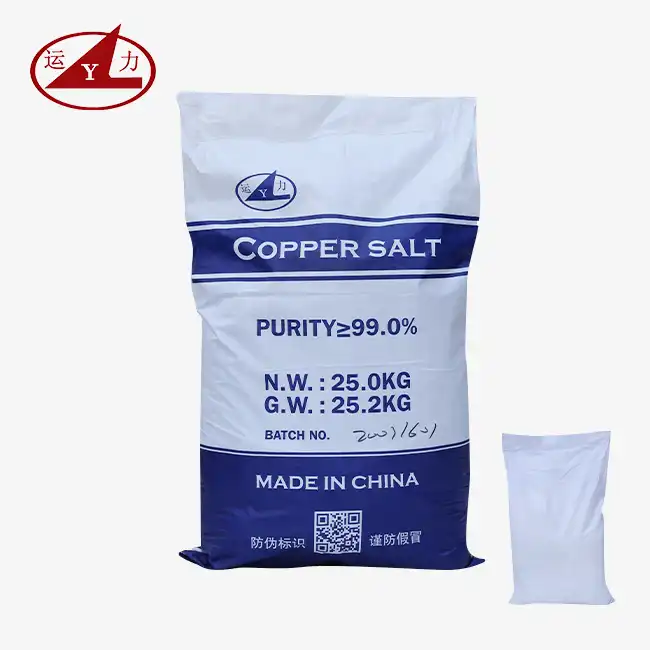
Because hydrogen bonds make things more hygroscopic, they need packing that keeps wetness out. We ship materials in HDPE drums with inner liners to keep the purity of the goods while they are being shipped by ocean freight. There are different types of packaging, from 25 kg bags for small batches to 1000 kg big sacks for large operations. Liquid formulas in different ratios get rid of the need for on-site dissolution steps. This saves time and ensures that the solution strength stays the same. This choice is especially helpful for metal finishing jobs where uniformity from batch to batch affects the quality of the surface treatment.
Regulatory Compliance and Transportation
Shipping nitrates with the UN classification 1477 (Nitrates, Inorganic, Class 5.1, Packing Group II) needs the right hazard paperwork. Our export department handles all the necessary paperwork, such as business invoices, packing lists, and safety statements that meet US import standards. Shipments going to Europe must have both REACH pre-registration and RoHS safety certificates. Yunli Chemical has been exporting for more than 20 years and has built up strong transportation partnerships that ensure on-time delivery to US ports. Our history of working with big, international companies shows that we can be trusted to keep our service promises.
Supplier Evaluation Criteria
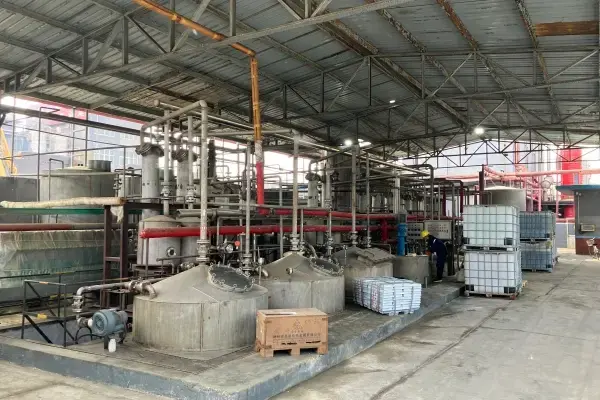
Aside from price, what sets one provider apart from another is their technical help. Our engineering team helps you get the most out of your applications by suggesting the right grades for making catalysts or making custom pH changes for electroplating baths. This conversational method cuts down on the costs of making mistakes while validating a product. Stable supplies are very important for planning production. Our 300 million yuan in fixed assets and wide range of raw material sources reduce the chances of interruptions. Long-term contracts that agree to a certain amount of output get better prices and are sure to be filled when the market is short. Standardized production methods that are approved by ISO 9001 ensure that the quality of each batch is the same. Statistical process control makes sure that factors like particle size distribution (20-80 mesh standard) stay within the allowed range. This keeps automatic feeding systems from having problems.
Preparing and Using Copper Nitrate Trihydrate Solutions in the Laboratory
The linking structure of Copper Nitrate Trihydrate directly affects the right way to prepare and use solutions in the lab.
Dissolution Procedures
Ionic and hydrogen bonding interactions between the substance and room temperature distilled water make it easy to breakdown. Concentrations usually range from 0.1 M for scientific titrations to full solutions for studies on crystal growth. While gentle stirring speeds up the dissolving process, forceful stirring is not needed because the substance dissolves so easily. When mixing liquids or making solutions in ethanol, warming them up a little (30–40°C) may speed up the dissolving process without causing thermal decomposition. The solutions that are made have a unique blue color that comes from copper ions reacting with water. The strength of the color depends on the concentration.
Storage Stability
When kept in glass or plastic cases with tight lids and away from light and organic materials, aqueous liquids stay stable. Because the pH is acidic, breakdown processes that could form basic copper salts can't happen. Long-term storing, on the other hand, may cause percentage changes over time because water evaporates, so it's best to do a reanalysis every so often for quantitative purposes. Solid things need to be stored in dry conditions. Because it is hygroscopic, copper changes its real copper value per gram when it comes into contact with humidity. Silica gel desiccant packs are used in our packaging to keep the quality of the goods until they are opened.
Laboratory Applications
This chemical is used as a copper standard in analytical chemistry for spectrophotometric and electrical tests. Accurate calibration curves are made possible by the high purity and uniform makeup. Researchers in the field of materials science use it as a starting material to make copper oxide nanoparticles using controlled precipitation or heat breakdown. For example, the molecule works well in teaching labs to show how coordination chemistry works. Students see how the color changes when it interacts with ammonia or other ligands. This shows how changes in bonding can affect electronic structures and optical features.
Conclusion
Copper Nitrate Trihydrate is a molecule that can be used in many different industrial chemistry areas because it has ionic, coordinate covalent, and hydrogen bonds. Knowing these basics about bonding helps you make smart buying choices, especially when it comes to pure standards, handling methods, and application optimization. Because it is easily dissolved, breaks down in a regular way, and has a high oxidizing capacity, the compound is essential for making catalysts, finishing metal, and making specialty chemicals. To make implementation work, you need to work with suppliers who can provide regular quality, expert support, and reliable transportation. These are things that set strategic supply relationships apart from commodity deals.
FAQ
What is the primary bond type in Copper Nitrate Trihydrate?
Copper(II) cations and nitrate anions interact with each other mainly through ionic links in this molecule. Coordinate covalent bonds connect three water molecules to the center of the copper atom, and hydrogen bonds keep the crystal structure stable. This mix shows how the substance dissolves, how it reacts to heat, and how it absorbs water.
How do water molecules affect the compound's stability?
Copper and water molecules form stable hydration shells when oxygen atoms donate their electrons. Compared to the dry form, this coordination makes it easier to dissolve and lessens its sensitivity. But it also makes things hygroscopic, which means they need to be stored in a way that controls wetness. Because differences affect stoichiometric calculations in industrial processes, the water level needs to be checked by analysis.
Can Copper Nitrate Trihydrate replace copper sulfate in electroplating?
Yes, especially when sulfate ions cause unpleasant side effects or problems with the chemistry of the bath. The nitrate form is better at conducting electricity and makes deposits that stick to some surfaces more smoothly. But bath composition changes might be needed because oxidation potentials and pH levels are different from sulfate-based electrolytes.
Partner with Yunli Chemical for Premium Copper Nitrate Trihydrate Supply
You can trust Yunli Chemical as a Copper Nitrate Trihydrate producer because they provide high-quality materials backed by 20 years of production experience and the ability to function as a provincial-level technology center. Our ISO 9001, ISO 14001, and OHSAS certifications make sure that the quality is always the same, that we follow environmental rules, and that all of our products are handled safely. We offer different levels of purity, from industrial 98% to ultra-pure 99.99%, and we keep the iron content below 30 ppm for catalyst uses. No minimum order amount is needed for flexible buying, which works for both trial samples and tonnage-level contracts. Our self-operated export team handles all shipping processes and regulatory paperwork, making sure that goods get to US facilities on time. As part of technical help, applications are optimized, custom formulations are made, and full COA paperwork is created. You can talk to our procurement experts about your needs and get reasonable quotes for your next order by emailing wangjuan202301@outlook.com.

References
1. Cotton, F.A. and Wilkinson, G. (1988). Advanced Inorganic Chemistry, Fifth Edition. New York: John Wiley & Sons.
2. Greenwood, N.N. and Earnshaw, A. (1997). Chemistry of the Elements, Second Edition. Oxford: Butterworth-Heinemann.
3. Patnaik, P. (2003). Handbook of Inorganic Chemicals. New York: McGraw-Hill Professional.
4. Perry, D.L. (2011). Handbook of Inorganic Compounds, Second Edition. Boca Raton: CRC Press.
5. Lide, D.R. (2004). CRC Handbook of Chemistry and Physics, 85th Edition. Boca Raton: CRC Press.
6. Seidell, A. and Linke, W.F. (1965). Solubilities of Inorganic and Metal-Organic Compounds, Fourth Edition. Washington: American Chemical Society.