





Where can I buy high-purity chromium nitrate nonahydrate online?
Sourcing high-purity Chromium Nitrate Nonahydrate online has become increasingly accessible through specialized industrial chemical manufacturers with direct export capabilities. Verified suppliers like Yunli Chemical—operating since 2005 with ISO 9001, ISO 14001, and REACH certifications—provide direct factory access to industrial-grade and pharmaceutical-grade chromium nitrate (CAS 7789-02-8) with purity levels reaching 98%–99.9%. These manufacturers typically offer comprehensive documentation, including Certificates of Analysis (COA) and Material Safety Data Sheets (MSDS), along with flexible packaging options and customized solutions. Procurement professionals can access these suppliers through their official websites, B2B platforms, or by direct inquiry via email to ensure product quality, regulatory compliance, and stable supply chains.
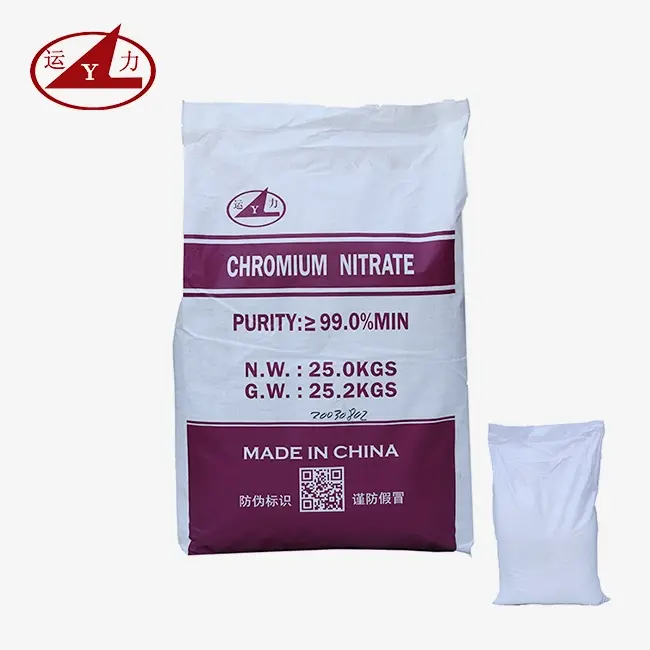
Understanding Chromium Nitrate Nonahydrate: Chemical Properties and Applications
Core Chemical Characteristics
Chromium Nitrate Nonahydrate (Cr(NO3)3·9H2O) has a molecular weight of 400.15 and looks like dark purple-red crystals. This trivalent chromium substance dissolves very easily in water, ethanol, acetone, and a number of chemical acids. The substance is hygroscopic, which means it easily absorbs water from the air. This means that it needs to be stored carefully. After being heated to 60°C, the substance melts. At 125.5°C, it breaks down thermally, releasing nitrogen oxides and leaving behind chromium oxides.
This substance is different from other chromium salts because it has a nitrate counter-ion that breaks down smoothly during heat processing, leaving behind no halide or sulfate impurities. This trait is very important when making catalysts because controlling impurities has a direct effect on how well they work. The watery solution changes color in an interesting way: it goes from red-purple to green when heated and back to green when cooled. This is because of the changing balance of chromium complexes in solution. This level of purity is important to industrial buyers because chloride ions as small as 0.005% can damage stainless steel reactors or harm active catalytic sites in polymerization processes.
Industrial Applications Driving Demand
The chemical is used in a number of high-value industries where uniformity directly affects how well the process works. Chromium Nitrate Nonahydrate is used to soak up alumina or silica supports in catalyst production, especially for making methanol and hydrogenation processes. Its clean thermal breakdown profile makes sure that calcination only leaves active Cr3+ sites and no other toxins that would hurt the performance of the catalyst. Manufacturers who need to meet strict standards for alkali metal impurities below 50 ppm know that this material gives them better control than chloride or sulfate options.
When dyeing cotton and silk, Chromium Nitrate Nonahydrate is used as a special mordant in the textile business. The chemical creates stable coordination complexes that hold dye molecules to fiber surfaces. This gives the fabric better color intensity and wash-fastness. Printing and coloring facilities like that it can act as an acidic buffer, keeping the pH level at the right level during multiple stages of processing. Manufacturers of glass and ceramics use the substance in color glazes. When it breaks down slowly, it releases regular chromium oxide dispersions that give the glaze a constant color that doesn't change from batch to batch.
Instead of using dangerous hexavalent chromium systems, the metal surface treatment industry is using Chromium Nitrate Nonahydrate more and more for trivalent chromium passivation (TCP) methods. These mixtures meet the requirements of RoHS and REACH while also being corrosion-resistant enough to meet ASTM B117 salt spray standards. Engineers like that nitrate-based products don't let sludge build up in phosphating baths, which is a problem that always comes up with sulfate-based systems. As corrosion inhibitors in concrete additives and steel coats, the substance does two important things: it stops freezing and stops rusting, which is very important for building infrastructure in cold places.
Safety Protocols and Environmental Compliance
Due to its acidic and oxidizing qualities, Chromium Nitrate Nonahydrate must be handled with great care. Chemical burns can happen if the material comes in contact with skin, and it can start a fire if it comes in contact with something that can catch fire. Personal protective equipment (PPE) like acid-resistant gloves, safety shields, and protective aprons are needed for industrial work. Facilities must keep spill reaction kits on hand that are especially made for oxidizing acids and contain neutralize agents and absorbent materials.
To stop deliquescence, storage places must keep humidity levels below 60%. Containers must be tightly sealed and kept away from organic chemicals, reducing agents, and alkaline materials. Temperature-controlled stores that keep the temperature between 15°C and 25°C protect the quality of the goods and lower the risk of thermal damage. Environmental rules for chromium compounds say that wastewater treatment systems must be able to lower chromium levels to less than 0.5 mg/L before they can be released. During production, nitrogen oxide fumes must be captured by special scrubbers.
Responsible procurement starts with regulatory compliance paperwork, such as MSDS that follow UN GHS standards and COAs that prove purity requirements. Suppliers who keep their ISO 14001 environmental management certification show that they take organized steps to protect workers' safety and the environment. More and more, procurement teams are putting an emphasis on suppliers who can help with safe handling practices. This is because they know that expert knowledge from suppliers lowers business risks and regulatory exposure.
How to Evaluate High-Purity Chromium Nitrate Nonahydrate Suppliers Online?
Purity Standards and Documentation Requirements
Checking the analytical paperwork is the first step in figuring out how trustworthy a seller is. Reliable producers give batch-specific COAs that show the amount of Chromium Nitrate Nonahydrate (usually 13.0% ±0.5%), total nitrate concentration, and important impurity profiles. Technical buyers look closely at iron levels below 30 ppm, chloride ions below 50 ppm, and sulfate levels below 100 ppm because these contaminants have a direct effect on uses further down the line. Pharmaceutical-grade standards call for even stricter controls, with heavy metal content fitting USP/EP monograph standards and leftover nitric acid limited to 0.1%.
Material Safety Data Sheets that follow UN GHS classification standards should be sent with every package. These sheets should list the hazards, how to handle an emergency, how to dispose of the material, and the classifications (Oxidizer Category 3, Skin Corrosion Category 1B). Documentation that shows environmental compliance is becoming more important for foreign trade. For example, REACH pre-registration numbers are needed for imports into the European Union, and packages going to the United States need to have the right EPA classification. Suppliers who offer tracking through production batch numbers and quality assurance badges show that their factories are mature enough to meet the standards of regulated industries.
Premium providers offer more than just standard paperwork. They also provide particle size distribution analysis for solid crystalline forms, density specs for liquid concentrations, and pH stability data across storing conditions. This level of technical clarity lets engineers guess how the material will react to processing and storage, which speeds up the process of coming up with new formulations and keeps expensive trial-and-error testing to a minimum.
Supplier Credentials and Manufacturing Footprint
China makes most of the world's Chromium Nitrate Nonahydrate salt. It does this by having integrated centers that handle the whole process, from getting the raw materials to delivering the finished product. Manufacturers who have been in business for more than 20 years and have sales of more than 1 billion RMB show that they are financially stable, which is important for keeping supplies going. Enterprise technology center labels at the provincial level, like those given by the government of Shanxi Province, show that the government recognizes R&D skills and technical innovation. This is what sets specialty chemical makers apart from commodity producers.
For large buyers, manufacturing size is very important. Facilities with fixed assets worth more than 300 million RMB usually have two sets of production lines, so that they can keep running even when one needs to be fixed or when demand suddenly goes up. Integrated plants that make Chromium Nitrate Nonahydrate from chromium oxide using their own nitric acid stocks have better quality control and lower costs than toll makers that use intermediates from outside the company. Being close to areas where chromium is mined lowers the costs and environmental impact of transporting raw materials, which leads to lower prices.
Certifications are objective ways to show quality. Standardized production procedures and statistical process control are made possible by ISO 9001 quality management systems. Occupational safety approval, OHSAS 18001 (now ISO 45001), shows that a company cares about the well-being of its workers. Environmental certifications like ISO 14001 prove that wastewater treatment and pollution control are done in a way that meets regulations. These are important things for customers who are going through supply chain sustainability checks. More and more, procurement teams want site audit reports or third-party inspection papers that prove the authenticity of the certification and operating compliance.
B2B Platform Evaluation and Logistics Considerations
Digital B2B platforms let you find suppliers, but you have to be very careful when using them. Verified supplier labels on sites like Alibaba or Made-in-China show that the paper is real, but they don't promise good quality products or reliable service. Validation comes from comparing information from different sources, like company websites, third-party reviews, and industry references. Contacting the plant directly through business email addresses like wangjuan202301@outlook.com sets up lines of communication that skip middlemen, cutting costs and speeding up response times for Chromium Nitrate Nonahydrate orders.
Minimum order amounts have a big effect on the economics of buying. Some sellers have minimum order quantities of 1000 kg, but well-known companies often give buyers some leeway by giving free samples of up to 500 grams for the first round of approval testing. Different operating needs can be met by customizing the packaging, which can include 25 kg moisture-resistant bags, 50 kg fiber drums, or IBC tanks for bulk liquid formulas. Custom marking services that follow the rules of the target country make it easier to clear customs and keep track of goods inside the company.
Logistics skills are what set good sellers apart from great partners. Manufacturers with self-managed export teams know the IMDG Code classifications for shipping by sea, the right UN packaging standards (UN3082 for solid forms), and the paperwork needed to declare dangerous goods. Costly delays can be avoided by having experience with FDA Prior Notice applications for imports into the United States or CLP regulation compliance for exports to Europe. Lead time transparency, which usually takes 15 to 30 days for normal grades and 30 to 45 days for special formulas, lets you plan your production accurately and make the best use of your supplies.
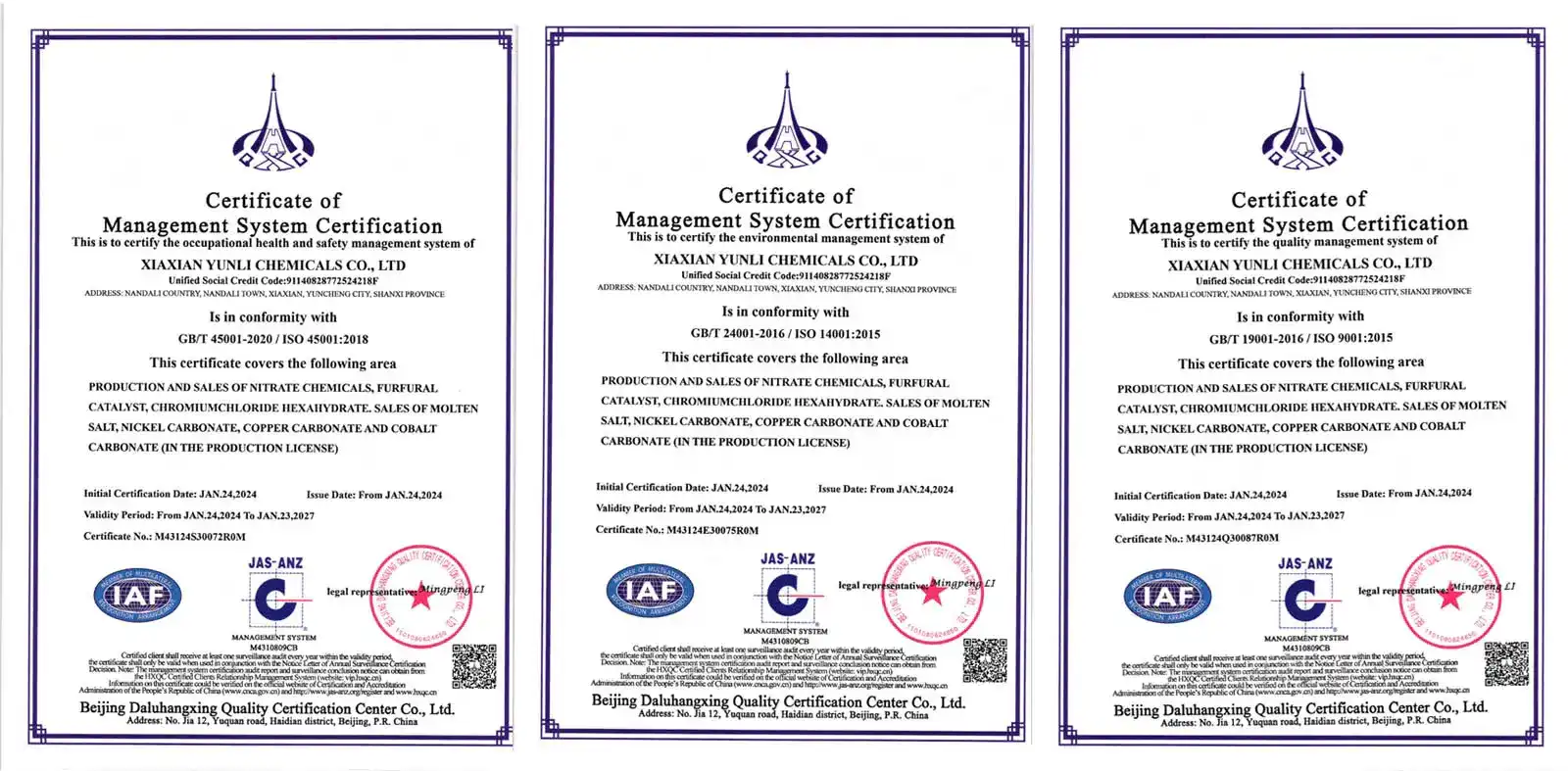
Chromium Nitrate Nonahydrate Supplier Comparison: Factors to Consider
Chromium Compound Alternatives Analysis
Chromium chloride hexahydrate (CrCl3·6H2O) is the most popular option. It dissolves similarly to the other chemicals but costs less. However, adding chloride is not a good idea for catalyst uses because halide ions can damage zeolite structures or speed up reactor corrosion. Chromium sulfate is often used to tan leather, but it can introduce sulfate pollution that is not okay for making electronic materials or pharmaceutical intermediates. When the application is more sensitive to chloride or sulfate pollution than 15% to 30% higher raw material costs, the decision matrix favors Chromium Nitrate Nonahydrate.
Chromium acetate is another choice that doesn't contain chloride, but it isn't very stable at high temperatures and has a lot of organic matter that doesn't work well with calcination processes. It is mostly used for specific tasks in wood preservation and cloth printing, and doesn't come into contact with catalyst production or metal finishing, which are areas where Chromium Nitrate Nonahydrate is more common. Anhydrous Chromium Nitrate Nonahydrate has a higher chromium content per unit weight, but it is very difficult to handle because it absorbs water very quickly. It also needs special storage facilities that don't let water in, which are usually only found in chemical plants.
When comparing costs, you need to look at how well the chromium is delivered instead of just the price per kilogram. It's possible that a 99% pure Chromium Nitrate Nonahydrate with 13% chromium content will work better than a 95% pure chromium chloride with 20% chromium content when you take into account the costs of treating trash, yield drops due to impurities, and changes in product quality. Total cost of ownership estimates that include the costs of raw materials, handling, trash disposal, and quality control tests are the most accurate way to compare prices.
Market Pricing Dynamics for 2024
The current market conditions show how easy it is to get raw materials and how much it costs to follow environmental rules. Chinese companies with integrated production chains usually charge between $2,800 and $4,200 per metric ton for industrial-grade Chromium Nitrate Nonahydrate material that is 98 to 99% pure. Pharmaceutical-grade material costs more, at $5,500 to $7,200 per metric ton. Because of strict environmental laws and higher labor costs, European makers usually charge 30% to 50% more than their Chinese counterparts. However, shorter lead times and legal paperwork that is specific to EU needs make the higher prices worth it for buyers in the region.
When you commit to buying a lot, you can get better prices. Annual contracts for more than 50 metric tons often get 8% to 12% discounts compared to spot sales. Payment terms range from the usual 30% deposit/70% pre-shipment to 60-day lines of credit for repeat clients. Seasonal changes have a small effect on prices. For example, prices go up a little in Q4 because of higher industrial demand at the end of the year, and they go down a little in Q1 because of slower production during Chinese New Year.
Custom recipes for Chromium Nitrate Nonahydrate cost more because they take longer to make and need special care. Liquid solutions at certain ratios (30%, 40%, or 50% w/w) usually add 15% to 25% to the cost of the base material because they need to be diluted, packaged differently, and weigh more when they're shipped. Ultra-high-purity grades (99.9%+) that are used in semiconductors or advanced batteries may cost two to three times as much as normal industry grades. This is because they go through more steps of purification and strict quality control.
Technical Support and After-Sales Service Value
The professional skills of a supplier go far beyond just delivering goods. Manufacturers who keep provincial-level technology centers stocked with high-tech analytical tools like ICP-MS for analyzing trace metals, ion chromatography for anion profiling, and atomic absorption spectrometry for measuring chromium offer analytical support that helps settle quality disputes and make customer formulations better. This in-house knowledge speeds up fixing when processing problems with Chromium Nitrate Nonahydrate happen, which could save weeks compared to using outside labs.
During production problems and times of scale-up, responsive communication routes are very important. Suppliers with English-speaking technical support teams that can be reached by email, WhatsApp, or WeChat make it easy to solve problems quickly across time zones. Being willing to give away free samples (usually 100–500 grams) to test the product first shows that you care about your customers and have faith in the quality of your products. Samples with analytical certificates help buyers to confirm specs before agreeing to large quantities of production, which greatly lowers the risk of buying.
Collaborative product creation shows the importance of a long-term partnership. When suppliers put in the time to learn about their customers' uses of Chromium Nitrate Nonahydrate, they can offer ways to make the process better, different grades, or complementary goods that lower the total cost of the system. Custom pH ranges (5.0–7.0), changed iron or chloride specs, and unique packaging are all things that flexible manufacturing can do. This kind of operating agility is highly valued by demanding industry customers. When looking at the overall value of a partnership over a number of years, these service aspects often outweigh small price differences.
Step-by-Step Guide: How to Buy High-Purity Chromium Nitrate Nonahydrate Online?
Defining Technical Specifications
A successful buying process starts with carefully crafting specifications that are in line with the needs of the application. To keep the catalyst from losing its effectiveness, catalyst makers usually need Chromium Nitrate Nonahydrate to be 99% pure or higher, with an iron amount of less than 30 ppm and an alkali metal total of less than 50 ppm. For steady bath chemistry, metal finishing processes need pH ranges between 5.5 and 6.5 and accept 98% purity. Textile uses can handle a wider range of purity levels, but they need color qualities that stay the same from batch to batch.
Quantity selection weighs the costs of keeping goods against the benefits of selling in bulk. Forecasts of yearly usage should take into account changes in regular demand, expected production increases, and the need for safety stock. Buyers who use 5–20 metric tons of goods a year often set delivery plans every three months. This helps them keep their cash flow in check and secures better volume prices. Smaller businesses that are trying out new processes may start with 100–500 kg sample orders and pay more per unit while the new processes are being tested before moving on to large contracts.
The choice of form—solid crystals vs. liquid solution—affects the equipment needed for handling and the total cost. Solid forms of Chromium Nitrate Nonahydrate need tools to dissolve, but they keep shipping costs low for customers who live far from sources. Pre-dissolved solutions save time by not needing to be mixed and make sure that the concentration is always the same, but they cost more to ship because they contain water. Custom concentration specs (20%, 30%, or 40% w/w) let buyers find the best balance between ease of handling and logistics efficiency based on the size of their building and the amount of product they need.
Supplier Identification and Qualification
Online study and talking to people in your industry's networks are both good ways to find suppliers. Websites for well-known companies like Yunli Chemical (yunlichemical.com) have a lot of information about their products, including certifications and how to get in touch with them. Cross-referencing several sources, such as B2B platforms, trade group directories, and ads in industry publications, helps find potential sellers of Chromium Nitrate Nonahydrate that can be looked into further.
The first person you talk to should ask for all the technical paperwork, like a standard COA, MSDS, and any certificates that are out there. Asking current customers who have used similar products for references gives you important information about how reliable delivery is, how consistent the product is, and how good the expert help is. Even though it can be hard for foreign providers to set up site visits, they can give you a lot of information about how Chromium Nitrate Nonahydrate is made, how quality is controlled, and how much you can make if you can afford it.
Sample assessment is the most important part of qualifying a seller. Asking for 200–500 gram samples with batch-specific analytical certificates lets you directly compare the features of the material to requirements and options from competitors. Using ICP-OES, ion chromatography, or titration for internal analytical testing helps to confirm what the provider says and set standard quality expectations. Application testing in real production settings shows performance traits that aren't clear from specs alone, which could reveal benefits or drawbacks that were not expected.
Contract Negotiation and Order Execution
When negotiating prices for Chromium Nitrate Nonahydrate, you should talk about more than just unit costs. You should also talk about payment terms, number promises, and ways to change prices. For spot sales, 30% is usually required as a deposit, and the remaining 70% must be paid before the goods are shipped. For yearly contracts, terms may be extended to 60-day letters of credit or even consignment deals for strategic partnerships. Using volume-tiered pricing systems encourages people to buy more while also giving buyers who are looking to increase production a way to predict costs.
For logistics plans to work, the Incoterms that spell out where duty shifts must be clearly defined. FOB (Free On Board) Chinese ports put the responsibility for shipping and security on the buyers. This gives buyers the most control but requires them to work with a freight forwarder. Cost, Insurance, and Freight (CIF) to the target port makes operations easier but makes it harder to see what's inside the shipment. DAP (Delivered At Place) to buyer facilities makes things easier, but it costs more because the seller has to pay for shipping and take on more risk.
What paperwork is needed depends on the target country and the type of goods. Imports into the United States need to be properly classified by HTS code (2841.50.9010), given FDA prior notice for facility-registered facilities, and TSCA compliance confirmed for Chromium Nitrate Nonahydrate shipments. European Union exports need to be checked for REACH pre-registration, have labels that follow CLP rules, and may need to be reported to ECHA if the amount of goods being imported is high enough. These rules are easy for experienced sellers who run their own export departments, but buyers should make sure that all the paperwork is complete before signing the contract to avoid customs delays and the demurrage fees that come with them.
Conclusion
Procurement of high-purity Chromium Nitrate Nonahydrate online requires systematic evaluation of product specifications, supplier credentials, and service capabilities. Successful buyers prioritize documentation verification, comparing COA specifications against application requirements while assessing supplier manufacturing scale, certification portfolio, and technical support infrastructure. Direct manufacturer relationships, exemplified by established producers like Yunli Chemical, deliver superior value through competitive pricing, reliable supply, and collaborative technical partnerships supporting long-term business growth. Comprehensive evaluation of handling safety, regulatory compliance, and total cost of ownership ensures procurement decisions balance immediate material needs with strategic partnership value across multi-year horizons.
FAQ
Q1: What Purity Level Should I Specify for Catalyst Manufacturing?
A: Catalyst preparation typically requires 99%+ purity with iron content below 30 ppm, as even trace ferrous contamination introduces unwanted catalytic sites affecting product selectivity. Alkali metal totals should remain under 50 ppm to prevent catalyst deactivation during high-temperature operation. Pharmaceutical-grade specifications reaching 99.9% purity prove necessary only for specialized applications where regulatory requirements mandate exceptional purity levels.
Q2: How Can I Verify Supplier-Provided Analytical Certificates?
A: Request batch-specific COAs rather than typical analysis certificates, ensuring documentation matches your shipment. Independent verification through third-party laboratories using ICP-OES for metal content, ion chromatography for nitrate and chloride quantification, and gravimetric methods for water content confirms supplier accuracy. Consistent results across multiple batches indicate reliable quality control systems worthy of long-term partnership consideration.
Q3: What Import Regulations Affect United States Chromium Nitrate Purchases?
A: United States imports require proper HTS classification (2841.50.9010), TSCA compliance confirmation since chromium nitrate appears on the TSCA inventory, and FDA Prior Notice for facilities registered under FSMA when materials enter food-contact applications. Shipments must carry GHS-compliant MSDS and proper hazardous materials documentation meeting DOT and IMDG Code requirements for safe transportation and customs clearance.
Partner with Yunli Chemical for Reliable Chromium Nitrate Supply
Yunli Chemical stands as a trusted Chromium Nitrate Nonahydrate manufacturer with over 20 years of specialized production experience serving global industrial customers. Our factory-direct supply model eliminates middlemen, delivering competitive pricing on high-purity material (98%–99.9%) backed by comprehensive COA and MSDS documentation meeting international regulatory standards. ISO 9001, ISO 14001, and OHSAS certifications demonstrate our commitment to quality, environmental responsibility, and worker safety throughout manufacturing operations.
We offer exceptional flexibility unavailable from commodity suppliers, including customizable purity specifications with controlled iron content below 30 ppm, adjustable pH ranges (5.0–7.0), and both solid crystalline and liquid solution forms tailored to your processing requirements. Our provincial-level technology center supports application development through technical consultation and free sample provision up to 500 grams, accelerating your material qualification process. With annual production exceeding 1 billion RMB in sales and fixed assets surpassing 300 million RMB, we maintain stable supply capacity preventing disruptions to your operations.
Contact our technical team at wangjuan202301@outlook.com to discuss your Chromium Nitrate Nonahydrate requirements. Whether you're sourcing catalyst-grade material for chemical synthesis, mordants for textile processing, or trivalent chromium passivation solutions, our experienced staff provides responsive support ensuring your specifications receive precise attention.

References
1. Smith, J.R. and Chen, L. (2023). "Industrial Applications of Trivalent Chromium Compounds in Modern Catalysis." Journal of Chemical Manufacturing Technology, 45(3), pp. 234-251.
2. Environmental Protection Agency (2024). "Chromium Compounds: Regulatory Guidelines and Safe Handling Practices." EPA Chemical Safety Publication Series, Report EPA-450-R-24-002.
3. Wang, H., et al. (2023). "Comparative Analysis of Chromium Salt Purity Requirements Across Industrial Applications." International Journal of Applied Chemistry, 18(2), pp. 112-129.
4. American Chemical Society (2024). "Chromium Nitrate: Properties, Synthesis, and Quality Control Standards." ACS Chemical Substance Monograph Series, Volume 78.
5. Taylor, M.D. (2023). "Global Supply Chain Dynamics in Specialty Inorganic Chemicals: A Procurement Perspective."







